

Summary
In 2026, SMEs will win growth by running marketing as a disciplined operating rhythm, not a once-a-year planning exercise. This article explains the 90-day Transform Loop, a repeatable quarterly cycle of Review, Focus, Implement and Optimise that turns strategy into shipped work and measurable pipeline, even when time, people and budgets are tight. It also shows how to keep the loop aligned to annual direction so you avoid short-term tactics, while still making faster decisions on ICP, offer, proof and execution priorities every 90 days.
Created: 1 January 2026
Introduction
Your 2026 growth plan won’t fail because it’s wrong.
It’ll fail because it has no cadence.
Marketing Week reported 67% of SMEs have no marketing action plan.
No plan usually means no rhythm: nothing repeats, nothing compounds.
That is why growth needs a 90-day operating rhythm.
January looks tidy.
February gets messy.
March turns into “we’ll review next quarter”.
The core problem is not effort.
It’s cadence.
SME marketing usually fails because it tries to manage growth as a document, not as an operating system.
And when budgets are tight, you don’t get many chances to be wrong. One report on the Gartner CMO Spend Survey noted marketing budgets flatlining at 7.7% of company revenue. Whether you’re above or below that benchmark, the signal is the same: you can’t assume “more budget” will save weak prioritisation.
So here’s a simpler way to run growth.
Where annual planning still matters
Annual and longer-term strategy still matters. It sets direction, constraints and the big bets. The problem is using the annual plan as the operating rhythm.
The 90-day loop is the execution cadence that turns strategy into shipped work and measurable outcomes.
Run the 90-day loop without an annual guide and it becomes too tactical. You end up optimising activity, not building advantage. Run annual planning without a 90-day cadence and you get tidy documents and messy delivery.
The answer is both: strategy sets the “where and why”, the 90-day loop drives the “what and now”.
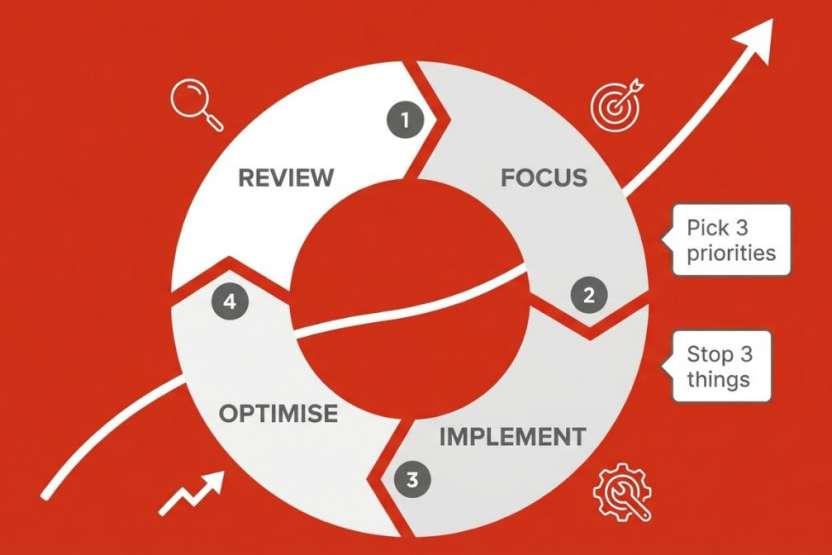
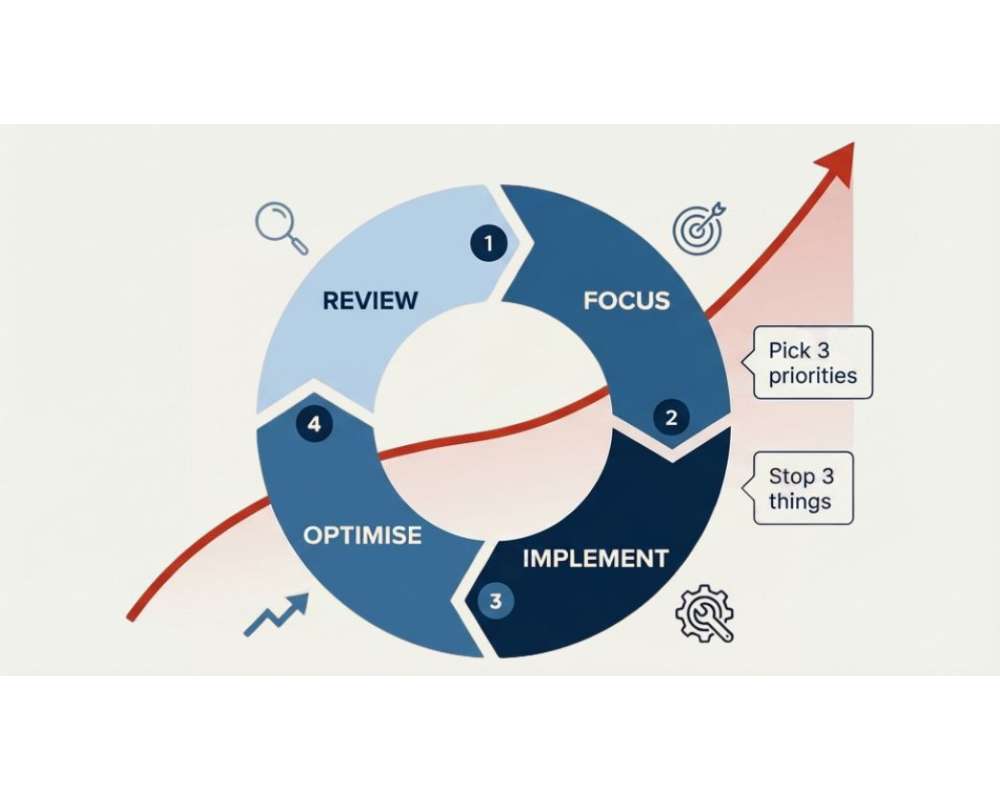
The 90-day Transform Loop

Timing matters. The loop is continuous, but to get full impact you should do Review and Focus before the quarter starts. That way you begin Day 1 with decisions already made and can run Implement and Optimise for the full 90-day period.
Runway (final 1–2 weeks before the quarter): Review + Focus
Execution (Day 1–Day 90 of the quarter): Implement + Optimise
Then, 1–2 weeks before the next quarter, you repeat Review + Focus again.
1) Review (Runway: 1–2 weeks before Day 1)
Goal: make decisions with evidence, not opinions.
What to review:
- pipeline and lead quality (not just traffic)
- which channels created qualified opportunities
- which offers are easiest to sell, and why
- where the funnel leaks (handover, response time, conversion)
- sales feedback: what objections repeat and what triggers “yes”
Output (one page):
- what worked
- what didn’t
- what we learned
- what we will change next quarter
2) Focus (Runway: lock decisions before Day 1)
Goal: choose fewer bets and fund them properly.
Make three decisions:
- ICP (Ideal Customer Profile): who are we targeting for the next 90 days?
- Offer: what are we selling them, and what do they get next?
- Proof: what evidence will remove risk for this buyer?
Then decide:
- 1 primary KPI (pipeline created OR qualified leads OR qualified meetings)
- 3 priorities for the quarter (the only funded bets)
- 3 things you will stop (so priorities have oxygen)
Sanity-check these choices against annual goals and positioning, so the quarter stays directional.
If you don’t stop things, you didn’t prioritise.
3) Implement (Execution: Day 1–Day 90)
Goal: ship weekly, not “launch eventually”.
Because Review + Focus happen in the runway, you start the quarter ready. The aim is simple: no ramp-up quarter. You begin Day 1 shipping.
Set a weekly cadence:
- 30 minutes: what shipped, what’s next, what’s blocked
- one owner per deliverable (no shared ownership)
- one definition of “done” before work starts
- weekly scoreboard: KPI trend + leading indicators
Most SMEs don’t need more ideas.
They need fewer projects that actually get finished.
4) Optimise (Execution: Day 1–Day 90, deeper once data stabilises)
Goal: improve results without increasing workload.
Optimisation rules that keep you honest:
- If it isn’t measured to revenue decisions, it’s a hobby.
- If it can’t be repeated, it’s not a strategy.
- If sales won’t use it, don’t build it.
A simple optimisation list:
- tighten messaging on the money pages
- add conversion tracking where it’s missing
- improve lead response time and handover
- build one reusable proof asset (case study, benchmark, pricing drivers)
- remove friction: shorten forms, improve CTA clarity, reduce steps to enquiry
A one-page quarterly plan (copy/paste)
If you want to run this without creating a big document, use this one-page structure each quarter:
Quarter: ___________________    Dates: ___________________

Annual anchor (1–2 lines):
__________________________________________________________

RUNWAY (T-14 to T-1)
Review: Worked / Didn’t / Learned:
- Worked: ________________________________________________
- Didn’t: _________________________________________________
- Learned: ________________________________________________

Focus decisions:
- ICP (next 90 days): _____________________________________
- Offer (and what happens next): __________________________
- Proof needed: ___________________________________________

Primary KPI (choose 1): Pipeline / Qualified leads / Meetings
Target: ___________________

3 priorities (only funded bets):
1) ______________________ Owner: ______ Done means: _______
2) ______________________ Owner: ______ Done means: _______
3) ______________________ Owner: ______ Done means: _______

3 stops:
1) ____________________  2) ____________________  3) ____________________

EXECUTION (Day 1 to Day 90)
Weekly cadence: shipped / next / blocked (30 mins)

Key deliverables (max 6):
- ________________________________ Owner: ______ Due: _____
- ________________________________ Owner: ______ Due: _____
- ________________________________ Owner: ______ Due: _____
- ________________________________ Owner: ______ Due: _____
- ________________________________ Owner: ______ Due: _____
- ________________________________ Owner: ______ Due: _____

Optimisation focus (top 3):
- ________________________________
- ________________________________
- ________________________________
Why this works for SMEs
Because it matches how real constraint works:
- limited time
- limited people
- limited budget
And it forces the thing most teams avoid: saying no.
A final note. If most SMEs don’t have an action plan, the answer isn’t a bigger plan. The answer is a plan you can execute, measure, and repeat every 90 days.
If you want to try this for your next quarter:
Run the runway (Review + Focus) before Day 1.
Then run Implement + Optimise for the full 90 days.
Repeat 1–2 weeks before the next quarter begins.
Sources
- Marketing Week: SME marketing plans (stats)
- Gartner: 2025 CMO Spend Survey (budgets)
- MediaPost: Summary coverage of Gartner budget findings
- Epitomise: Take advantage of tech-driven change
Like this? Share it!
About Epitomise:
We help SME and Technology companies use modern marketing strategies to grow. From strategic advice to tactical execution grow your business with the support of a 'top-100' award-winning marketing leader who is supported by a network of expert marketing specialists. With over 20-years' senior marketing experience and a track record of delivering results, as an attentive expert strategic marketing and services company, we help you grow your brand, leads, sales and customers by doing the right things the right way. Help for as long or as short as you need.