


Guide
ABM for SMEs including the use of AI
How to decide if Account-Based Marketing is right for you, and how to run it well with a small team and the support of artificial intelligence.
Most SMEs do not lose new business because their service is weak. They lose because the right companies, and the right people inside those companies, do not know they exist. Even when they have heard the name, they cannot quickly answer the question: "Why should we take this supplier seriously?"
That gap is not always down to a lack of effort. Many SMEs do marketing, but it is often a collection of disconnected activities: a few posts, an email here and there, a campaign when someone has time, a burst of outreach when sales gets quiet. It feels busy, but it does not build consistent awareness in the right accounts, or momentum with the people who shape decisions.
Account-Based Marketing exists for this situation. ABM is a way to concentrate effort so the accounts that matter most actually notice you, understand your relevance, and start to see evidence that you are credible. It is not a tactic. It is a decision to focus, and then run a disciplined approach for long enough to create real opportunity.
If your deals are meaningful, your sales cycles are longer, and buying decisions involve multiple stakeholders, ABM is often a more realistic route to pipeline than trying to generate more leads. It gives you a way to win attention and trust with the right accounts instead of competing for scraps at the end of a buying process.
This guide helps you decide if ABM fits your business, and what it looks like when an SME runs it properly over 90 days. It also explains where AI helps, and where it can cause damage if you use it carelessly.
Published: 6 February 2026
Last updated: 15 February 2026
Prefer to listen? Play the audio version of this article.
Who this is for: UK Tech SMEs, Software SMEs, App companies, and Professional Services SMEs focused on winning new customers with limited time and capacity.
Brand proof: See our Apptechnology case study
Contents
- Quick answer (for busy readers)
- Simple answer (one paragraph)
- What ABM means (and what it is not)
- The real question: is ABM right for us?
- What good ABM looks like for winning new accounts
- Where ABM typically breaks down (and how to avoid it)
- Decision framework: choose an ABM model that fits your capacity
- An 80/20 minimum viable ABM workflow (90 days)
- Governance and responsible AI for ABM
- Measurement for SMEs: prove progress without expensive tooling
- Common ABM mistakes (and fixes)
- FAQs (real prompts leaders ask)
- A final thought (and how we can help)
- Sources referenced
Quick answer (for busy readers)
- ABM is a focus decision: it works when you choose fewer accounts and do better work per account.
- ABM is often right when one or two wins change the year: you need depth, trust, and follow-up, not more leads.
- The unit of value is an account, not a lead: you are building confidence across a buying group, not chasing individual clicks.
- Start narrow enough to run weekly: if you cannot name the next action for every account, the list is too big.
- AI is useful for speed, not truth: use it to draft and organise work, then verify what matters.
- LinkedIn becomes powerful when it supports a workflow: stable lists, role coverage, timing signals, and disciplined outreach.
- Measure account progression: buying-group coverage, replies, meetings, opportunities created, and stage movement.
- ABM fails when it is marketing-only: if sales and marketing do not share the same accounts and next steps, activity rarely becomes pipeline.
Five money prompts this guide is designed to win
- How do we choose the right accounts for ABM without wasting months?
- What is the minimum viable ABM process a small team can actually run?
- How can AI help us target accounts and personalise outreach without making things up?
- How do we use LinkedIn and Sales Navigator to win new B2B customers?
- How do we measure ABM properly without hiding behind MQLs?
Simple answer (one paragraph)
Best-practice ABM for new business is a disciplined system for choosing a small set of high-value accounts, learning enough about those accounts to be relevant, engaging multiple stakeholders involved in the decision, and running consistent outreach over time until opportunities form. AI can help you move faster by drafting account briefs, organising research, creating role-based messaging variants, and keeping sequences consistent, but it cannot replace judgement or verification. LinkedIn and Sales Navigator support ABM when you use them to keep stable account and lead lists, expand buying-group coverage, spot timing signals, and run outreach with a weekly operating rhythm. For UK Tech, Software, App and Professional Services SMEs, the practical route is a right-sized ABM model measured by account progression and pipeline outcomes, run in repeatable 90-day cycles.
What ABM means (and what it is not)
What ABM is
ABM is a go-to-market approach where sales and marketing align around a defined set of accounts and treat those accounts as priority markets. Instead of optimising for lead volume, ABM optimises for relevance and progress inside target accounts: awareness, buying-group engagement, meetings, opportunities, and revenue.
What ABM is not
- Not a personalisation trick: personalisation is a tool. ABM is the choice to focus and follow through.
- Not just LinkedIn messages: LinkedIn is a channel. ABM is the operating model behind it.
- Not a substitute for positioning: if your message sounds like everyone else, ABM will not make it compelling.
- Not a guarantee: ABM improves your odds by improving relevance, timing, and consistency.
Why ABM exists (the reality most SMEs face)
The most strategically aligned companies, and the people who shape decisions inside them, often do not know you exist. Even when they do, they cannot quickly see why you are credible. ABM exists to solve that: concentrated effort, aimed at the accounts that matter, long enough to build recognition, relevance, and trust.
Account strategy and opportunity strategy
ABM works best when it connects to real account and opportunity thinking, not just campaigns. A practical way to keep this commercial is to use two simple templates:
- Account strategy: why this account, what matters to them, who is involved, what your angles are, and what you need to learn next.
- Opportunity strategy: once traction starts, what decision is being made, what risks and objections exist, who else matters, and what your plan is to progress.
The real question: is ABM right for us?
For SME leaders, the question is not "should we do ABM?" The practical question is: where will ABM create the most commercial leverage given our constraints?
A practical test
- Deal impact: would one or two new customers materially change the year?
- Decision complexity: do deals involve multiple stakeholders and risk concerns?
- Follow-up reality: can you run a weekly rhythm without relying on heroics?
- Credible proof: do you have evidence or methods you can stand behind?
- Willingness to focus: will leadership back a narrower list for at least 90 days?
If you are weak on ICP clarity, proof, or follow-up capacity, start with a short focus sprint first. ABM magnifies what is true about your targeting and message. If they are fuzzy, ABM exposes that quickly.
What good ABM looks like for winning new accounts
New-account ABM is a longer-term play. The objective is to build familiarity and confidence with the right companies and the right decision-makers and influencers, many of whom do not know you exist today. The value comes from disciplined steps, run consistently.
The ABM spine that keeps it practical
ABM works best when you treat it as a repeatable operating model, not a collection of tactics. This simple spine keeps teams focused on the steps that actually create new opportunities.
Select -> Understand -> Map -> Tailor -> Engage -> Advance -> Review
Select: choose a small number of accounts where a win would matter, and where you can credibly help.
Understand: research those accounts and their markets to build a detailed understanding of business drivers, structures, and pain points (annual reports can help where they exist).
Map: identify the likely buying group and influencers and build coverage across roles, not one contact.
Tailor: adapt your proposition and proof to the account and stakeholder role, without overclaiming.
Engage: develop a contact strategy and make consistent outreach feel welcome through insight and relevance.
Advance: earn a next step that progresses the account, not just a polite conversation.
Review: hold regular account and opportunity reviews so you keep focus on accounts that are genuinely moving.
LinkedIn and Sales Navigator as the ABM execution engine
LinkedIn supports ABM when you treat it as workflow, not a hopeful channel. That means stable account lists for a 90-day cycle, consistent content that supports your plays, and disciplined outreach that builds familiarity before asking for time.
- Build stable account lists: keep them consistent for 90 days so effort compounds.
- Build buying-group coverage: save multiple stakeholders per account and create role-based lead lists.
- Use alerts for timing: job changes, hiring, initiative posts, and partnerships often signal change.
- Use warm paths: reduce cold outreach by using shared connections and context.
How AI supports targeting and account intelligence (safely)
AI is most valuable when it makes preparation faster and execution more consistent. Use it to draft and organise work, then verify what matters. Keep it as an assistant, not an authority.
- Account briefs: draft one-page briefs from public information, then validate and refine.
- Role-based messaging: generate variants for different stakeholders while keeping the core story consistent.
- Sequences: create sequence options and follow-ups so execution does not stall, then edit for accuracy and tone.
- Meeting prep: generate discovery questions and meeting agendas to improve consistency.
Where ABM typically breaks down (and how to avoid it)
ABM breaks down for predictable reasons. The fixes are usually about focus, consistency, and credibility.
Red flags
- The target list is too big: if you cannot name the next action for each account, the list is not runnable.
- The ICP has no exclusions: an ICP with no negatives is wishful thinking.
- One contact per account: buying groups exist whether you map them or not.
- Inconsistent story: website, outreach, and calls sound like different businesses.
- Marketing-only ownership: if sales does not co-own accounts and next steps, activity will not become pipeline.
- AI adds false confidence: invented facts or confident assumptions destroy trust quickly.
Practical ways to stay credible
Keep the list small enough to run weekly. If you only have capacity for 20 accounts, do not run 80.
Use repeatable plays. Pick two or three plays you can run consistently.
Label what is known vs assumed. In every account brief, separate verified facts from hypotheses.
Require human review before outbound. This one rule prevents most credibility damage.
Align your website with your outreach. The first thing a target account does after an interesting message is check you out.
Decision framework: choose an ABM model that fits your capacity
Most SMEs do not need enterprise ABM. They need a right-sized model that creates pipeline without consuming the whole business. Use the options below to choose the simplest approach that fits your reality.
Option 1: ABM Lite (best when capacity is tight but you need new logos)
Best for: 1 to 2 people running outreach, limited campaign capacity, and a need for consistent new business activity.
Typical list size: 15 to 30 accounts.
90-day focus:
- Build a stable target list for 90 days and commit to a weekly rhythm.
- Save 3 to 6 stakeholders per account in Sales Navigator (role coverage matters).
- Run a 5 to 7 touch sequence per account that mixes insight, proof, and a simple next step.
- Hold a weekly account review to prioritise effort and maintain follow-up.
Common pitfalls:
- Trying to run ABM on too many accounts at once.
- Sending one message then stopping, which prevents momentum.
- Generic messaging that does not earn attention.
Option 2: Tiered ABM (best when deals are higher value and more complex)
Best for: longer sales cycles, multi-stakeholder decisions, and deals where a small number of wins changes the year.
Typical list size: 25 to 60 accounts in a tiered model (deeper work for fewer accounts).
90-day focus:
- Tier your accounts and decide where you will go deep vs where you will run plays.
- Define 2 to 3 repeatable plays (trigger, roles, insight, proof, next step).
- Build a minimum proof pack that supports the plays and aligns website and outreach.
- Use signals (alerts, hiring, role changes, initiatives) to prioritise weekly.
Common pitfalls:
- Trying to personalise deeply for too many accounts.
- Running too many plays and diluting learning.
- Not building buying-group coverage, so progress stalls.
Option 3: Focus Sprint then ABM (best when ICP or positioning is unclear)
Best for: businesses that are not yet confident about which accounts are truly best-fit or what story will win attention.
90-day focus:
- Spend 2 to 3 weeks tightening ICP and writing a negative ICP.
- Clarify your strongest proof and the claim you can stand behind.
- Test with a small number of accounts before committing to scale.
- Then run an ABM Lite cycle with better bets and a clearer narrative.
Common pitfalls:
- Starting outreach before your story is credible and differentiated.
- Choosing accounts based on hope rather than fit and access.
Option 4: Hybrid (best when inbound exists but quality is mixed)
Best for: businesses with some inbound flow but inconsistent lead quality, who want ABM for priority accounts.
90-day focus:
- Pick a priority account set and run ABM plays with consistent follow-up.
- Capture what messages and proof assets earn meetings and apply them to the website.
- Improve qualification and follow-up with a simple script and next-step rules.
Common pitfalls:
- ABM becomes a side project and never compounds.
- Inbound stays unchanged so quality does not improve.
Stop doing list (often the fastest route to ABM ROI)
- Stop trying to target everyone who could buy.
- Stop running generic campaigns you cannot follow up properly.
- Stop measuring success primarily by lead volume if your strategy is account focus.
- Stop writing outreach that claims certainty you cannot prove.
An 80/20 minimum viable ABM workflow (90 days)
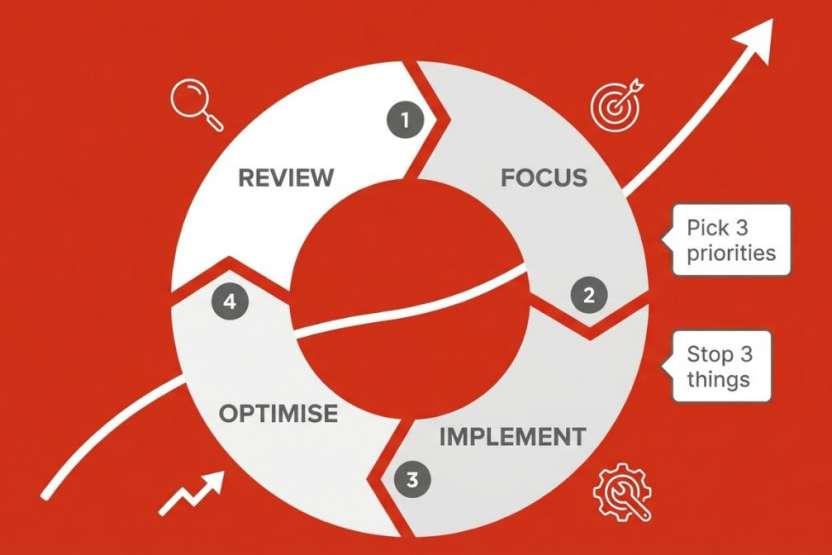
This is a practical 90-day ABM cycle a small team can run. It uses a simple operating rhythm: Review, Focus, Implement, Optimise.
Weeks 1 to 2: Review
- Tighten ICP and write a negative ICP
Use recent wins and lost deals to agree what to pursue and what to avoid. - Build your account universe and narrow it
Start with a wider list, then cut it to what you can execute weekly. - Create a one-page account brief template
Why this account, likely priorities, buying group roles, proof assets, next actions. - Use AI to draft briefs, then validate
AI can speed up drafting. Humans validate anything specific before outreach.
Weeks 3 to 4: Focus
- Tier your accounts
Small Tier 1 for deeper work, Tier 2 for segment plays, Tier 3 for lighter personalisation. - Map buying groups in Sales Navigator
Save multiple stakeholders per account and use alerts to improve timing. - Define 2 to 3 plays
Each play has a trigger, roles, core insight, proof, and a low-friction next step. - Build a minimum proof pack
One case study, one method overview, one diagnostic, and one insight page are enough to start.
Weeks 5 to 10: Implement
- Build familiarity
Publish consistent insights that support your plays and engage with target stakeholders. - Run sequences
Use a 5 to 7 touch structure and keep it human and useful. - Prioritise weekly using signals
Move effort towards accounts showing real change signals and warm paths. - Keep conversations consistent
Align website story, outreach, and sales calls so confidence builds.
Weeks 11 to 12: Optimise
- Review what progressed accounts
Which plays created replies, meetings, and opportunities? - Narrow further and double down
Remove accounts with no signal and expand buying-group coverage in accounts that are progressing. - Update the playbook
Capture what worked so the next 90 days is faster and more effective.
Governance and responsible AI for ABM
ABM works because it is relevant. It fails when it crosses the line into overreach. Be useful without being intrusive, and be confident without being inaccurate.
- Use legitimate sources and public information responsibly.
- Minimise personal data and store only what you need.
- Separate public fact from inference and label assumptions.
- Avoid sensitive inputs in AI tools unless you have safeguards.
- Require human review before outbound and validate facts and tone.
- Respect platform norms and avoid automation spam.
Measurement for SMEs: prove progress without expensive tooling
If you measure ABM like lead generation, you will create confusion. ABM is best measured by account progression and pipeline outcomes.
The 80/20 measurement stack
- Account list health: target accounts, tier coverage, and a clear next action per account.
- Buying-group coverage: stakeholders saved per account and role coverage.
- Meaningful engagement: replies, acceptance, meetings booked, quality conversations.
- Pipeline outcomes: meetings held, opportunities created, stage progression, closed-won.
A simple prompt scoreboard (low-cost and effective)
Create a small list of high-intent prompts your buyers and leaders would ask. Each month, check whether your brand appears when someone asks those questions in answer engines and search. Track what content gets cited and which pages are referenced. This is not perfect attribution, but it is practical direction.
Common ABM mistakes (and fixes)
Mistake: an ABM list that is too big. Fix: narrow until the next action is clear for every account.
Mistake: treating ABM as a campaign. Fix: run a weekly rhythm and learn in 90-day cycles.
Mistake: one contact per account. Fix: map buying groups and build role coverage.
Mistake: AI-written outreach sent without validation. Fix: human review and verified vs assumed separation.
Mistake: measuring ABM by MQLs. Fix: measure account progression and pipeline movement.
FAQs (real prompts leaders ask)
How many accounts should an SME target with ABM?
Start with what your team can execute consistently. Many SMEs do well with 15 to 30 accounts for ABM Lite, or 25 to 60 accounts in a tiered model. The right number is the number you can cover with buying-group mapping and disciplined outreach.
Does ABM work without paid ads?
Yes. ABM is a focus model, not an ad model. Paid can accelerate awareness, but disciplined LinkedIn execution and structured outreach can create meaningful pipeline without large budgets.
How do we use AI for ABM without risking credibility?
Use AI to draft and organise work, not to invent facts. Validate anything specific. Keep verified information separate from hypotheses. Make human review mandatory before outbound.
What should we say in an ABM message on LinkedIn?
Lead with a relevant insight, share proof you can stand behind, ask a simple diagnostic question, and invite a low-friction next step. Avoid generic claims and avoid pretending you know internal reality.
Is Sales Navigator worth it for ABM?
For many SMEs, yes. It adds structure: account lists, lead lists, filters, alerts, and warm-path visibility. The value comes from disciplined use, not the licence itself.
A final thought (and how we can help)
ABM is not complicated. It is disciplined. The hard part is choosing the right bets, aligning the team, and sticking to a repeatable process long enough to learn what actually works.
If you want a practical next step, download the playbook and use it as your working document to align sales and marketing around the same account list, the same plays, and the same weekly rhythm.
If you want it tailored to your niche and capacity, we can help you tighten your ICP, design a right-sized ABM model, and put a 90-day operating rhythm in place through our Transform Accelerator approach: Review, Focus, Implement, Optimise.
Brand proof: See our Apptechnology case study
Sources referenced
Sources referenced
- Gartner (2025): survey on sales rep work conflict (press release)
- Gartner (2025): B2B sales interactions shifting to digital (press release)
- Demandbase: 2024 ABM Benchmark Report landing page (claims and methodology summary)
- Forrester Total Economic Impact study (commissioned by Terminus): The Total Economic Impact of Terminus ABM (PDF)
- 6sense: The B2B Buyer Experience Report for 2025
- 6sense: The State of B2B Marketing Metrics in 2025
- Edelman + LinkedIn: 2025 B2B Thought Leadership Impact Report (PDF)
- LinkedIn: How to use Sales Navigator
- Demandbase: State of B2B Advertising (2nd edition) (PDF)
Like this? Share it!
About Epitomise:
We help SME and Technology companies use modern marketing strategies to grow. From strategic advice to tactical execution grow your business with the support of a 'top-100' award-winning marketing leader who is supported by a network of expert marketing specialists. With over 20-years' senior marketing experience and a track record of delivering results, as an attentive expert strategic marketing and services company, we help you grow your brand, leads, sales and customers by doing the right things the right way. Help for as long or as short as you need.