

Can AI Create a Marketing Strategy Without External Expertise?
Summary: Generative AI can draft a marketing strategy quickly, but it can’t make the hard choices that turn a document into a plan that wins: which customers to prioritise, what you want to be known for, how you’ll spend, what you’ll stop doing, and how you’ll manage risk. This guide shows where AI genuinely helps (faster synthesis, route creation, scenario drafting), where it can mislead SMEs (confident but untested assumptions), and why senior marketing leadership still matters most through direction, judgement, and governance. It also provides a practical, repeatable workflow you can run with a small team, so you can turn AI drafts into an execution-ready plan with clear trade-offs, evidence checks, and simple governance around data, claims, and privacy.
Published: 24 January 2026
Last updated: 24 January 2026
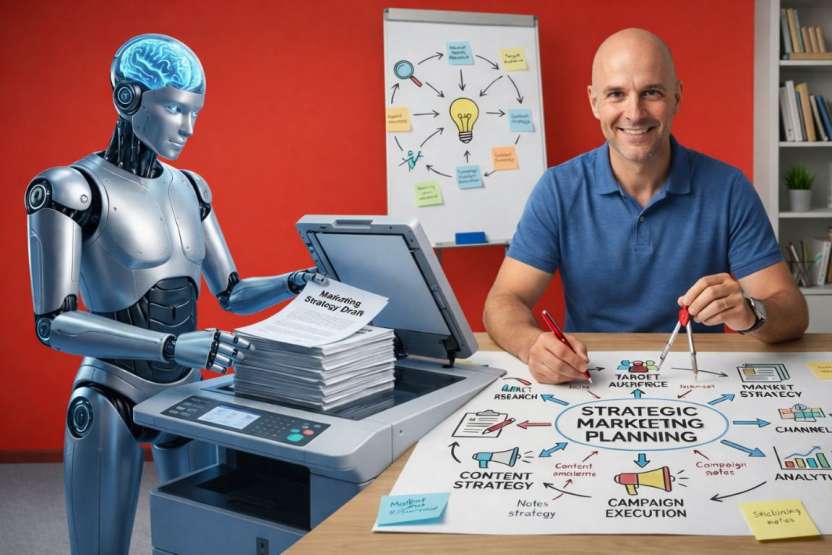
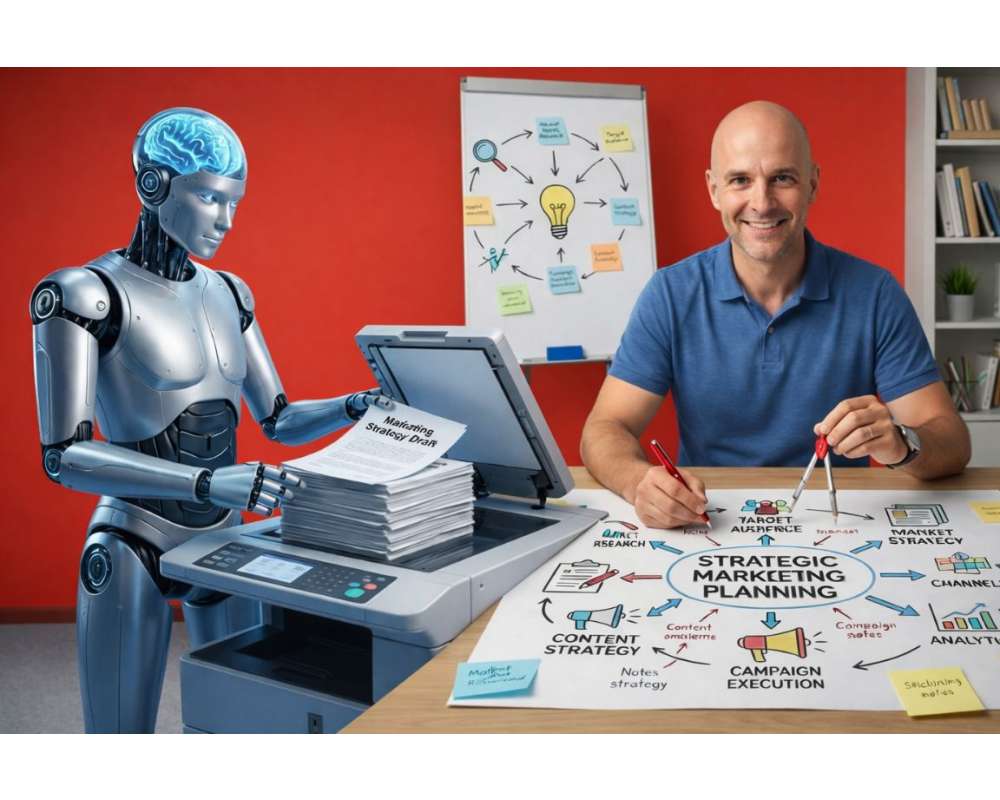
 AI accelerates drafting. Leadership provides direction, judgement, and governance.
Contents
- Quick answer (for busy readers)
- The simple answer (in one paragraph)
- What “marketing strategy” means (vs plan or campaigns)
- So, can AI do it without external expertise?
- Where AI genuinely helps (high-leverage use cases)
- Where AI misleads SMEs (the “fast wrong” failure modes)
- Decision table: DIY vs external expertise
- Why leadership matters more with AI
- A minimum viable AI-assisted strategy workflow (80/20)
- Governance and risk: data, claims, privacy
- How to measure if it’s working (without expensive tools)
- Common mistakes (and fixes)
- FAQs
- A final thought (and how we can help)
- Sources referenced
Quick answer (for busy readers)
If you only read one section, read this.
- AI can draft a strategy document fast, but it can’t make the accountable trade-offs that turn a document into a strategy that wins.
- You can create a workable strategy without external expertise only if you already have strong internal evidence, clear priorities, and someone senior who can make hard calls.
- The biggest risk is “fast wrong”: confident recommendations built on untested assumptions, generic best practice, or misread buyer intent.
- Use AI for speed-to-options (synthesis, route drafting, scenario planning, first drafts). Keep humans responsible for direction, judgement, and governance.
- For SMEs, the 80/20 move is: choose 1–2 priority segments, one positioning bet, one channel focus, and a stop-doing list for the next 90 days.
- If your plan includes budget allocation, differentiation, claims, or compliance risk, senior strategic marketing leadership becomes more valuable, not less.
- The best outcome is an AI-augmented process: AI generates credible routes; humans select one, validate evidence, and run a tight learning loop.
The simple answer (in one paragraph)
AI can help you create a marketing strategy document without external expertise, but it cannot reliably create a strategy you can bet the business on. A winning strategy is a set of accountable choices: which customers you prioritise, what you want to be known for, where you invest, what you stop doing, and how you manage risk. AI is strong at speed-to-options (research synthesis, route drafting, scenario planning) but weak at accountability, evidence checks, and resolving trade-offs under real constraints. SMEs get the best results when AI generates multiple credible routes and a senior decision-maker applies judgement, validation, and governance to select one coherent plan. If you lack internal evidence, clear priorities, or senior marketing leadership, external expertise can prevent “fast wrong” decisions that waste budget and slow growth.
What “marketing strategy” actually means (vs a plan or campaigns)
When SMEs say “strategy”, they often mean one of three different things. Separating them makes AI use safer and more effective.
- Strategy development: deciding where to play and how to win (target segments, positioning, trade-offs).
- Planning: turning those choices into a route map (budget logic, channel mix, priorities, timelines, KPIs).
- Execution: producing and running campaigns (assets, copy, landing pages, outreach, reporting).
AI helps most with planning and execution because those stages involve synthesis, drafting, and iteration. AI can assist strategy development by generating options, but it is not a decision-maker. Accountability stays with leadership.
So, can AI do it without external expertise?
Yes, it can create a document. That’s not the same as creating a strategy you can rely on. A strategy that wins is defined by the hard choices you’re willing to stand behind.
Here’s the practical test: if your draft strategy does not clearly state what you will stop doing, who you will not prioritise, and what trade-offs you’re accepting for the next 90 days, it isn’t strategy. It’s a set of ideas.
DIY is realistic when you already have good customer insight, a clear ideal customer profile (ICP), reliable conversion and pipeline data, and a senior person who can make trade-offs under uncertainty.
External expertise pays for itself when you have internal disagreement, unclear positioning, long sales cycles, limited budget, limited capacity, a complex offer, or brand/claims/compliance risk. In those cases, the cost of “fast wrong” decisions is usually higher than the cost of senior strategic marketing support.
 AI helps you move faster. Humans must decide what is true, what matters, and what you will do next.
Where AI genuinely helps (the high-leverage use cases)
AI’s biggest strategic value is speed-to-options. It collapses the slow parts of planning so you can spend your time where it counts: evaluating decisions.
Five uses that work in the real world
- Rapid category and competitor synthesis: summarise what competitors claim, the proof they use, and the segments they appear to chase.
- Draft segmentation hypotheses: propose 3–5 plausible segments and what each segment values (then validate with customer evidence).
- Generate positioning routes: write three distinct “we win because…” narratives that can’t all be true at once.
- Outline channel-mix scenarios: draft plans for “budget down 20%”, “new entrant undercuts on price”, or “sales cycle lengthens”.
- Turn messy internal notes into a coherent narrative: workshop notes, sales anecdotes, and board slides become a single plan people can follow.
Practical rule: always feed AI (1) your business constraints and (2) real customer/market evidence. Without both, it will produce something readable and generic.
McKinsey’s analysis of generative AI’s economic potential highlights meaningful productivity impact across functions (including marketing-related work). For SMEs, the best use of time saved is reinvesting into better decisions, not producing more noise.
Where AI misleads SMEs (the “fast wrong” failure modes)
The danger isn’t that AI produces nonsense. It’s that it produces plausible writing that reads like a competent consultant until you check the assumptions.
Six common failure modes
- Plausible-but-false “facts” (dates, market sizes, competitor moves).
- Generic best practice dressed up as insight (“build trust”, “be customer-centric”).
- Invented competitor claims (or real claims stitched together incorrectly).
- Misread buyer motives (confusing what buyers say with what drives purchase).
- Category clichés (“premium quality”, “innovative solutions”) that erase differentiation.
- No-trade-off strategies that try to please everyone, so they guide nobody.
A red-flag checklist (use this before approving the plan)
- Confident numbers with no source.
- Plans that ignore constraints (team capacity, sales motion, regulatory limits).
- Channel mixes that read like a default template.
- No “stop doing” list.
- Positioning that a competitor could copy-paste.
OpenAI has explained why language models can “guess” when uncertain, producing fluent output that still needs verification. TechCrunch has reported that some newer reasoning models may hallucinate more in certain internal tests. The practical implication is the same: treat AI output as a draft to verify, not a reference to trust.
 Fast drafting is helpful. Fast wrong is expensive.
Decision table: DIY vs external expertise
Use this as a quick test. If several items fall into “needs senior leadership” and you don’t have it in-house, external expertise is usually the fastest route to a plan that performs.
Market/competitor synthesis
- AI helps most with: Fast summarisation, drafting variants
- Humans must lead: Set direction, evaluate quality
- Risk if AI-only: Wrong assumptions
- 80/20 safeguard: Validate with real sources
Segmentation hypotheses
- AI helps most with: Proposing plausible segments
- Humans must lead: Validate with customer evidence
- Risk if AI-only: “Everyone” targeting
- 80/20 safeguard: Choose 1 primary + 1 secondary segment
Positioning options
- AI helps most with: Generating distinct narratives
- Humans must lead: Choose trade-offs, approve claims
- Risk if AI-only: Generic messaging
- 80/20 safeguard: Competitor copy-paste test
Channel-mix scenarios
- AI helps most with: Drafting plans for constraints
- Humans must lead: Select best strategic path
- Risk if AI-only: Shiny-object plans
- 80/20 safeguard: One capture + one nurture channel
Budget logic
- AI helps most with: Turning notes into coherent narrative
- Humans must lead: Own allocation decisions
- Risk if AI-only: Unrealistic spend
- 80/20 safeguard: Set a 90-day bet and stop-doing list
KPI model
- AI helps most with: Drafting KPI ideas and reporting
- Humans must lead: Define success and targets
- Risk if AI-only: Vanity metrics
- 80/20 safeguard: 5 KPIs max with owners and cadence
Risk/governance
- AI helps most with: Flagging potential issues
- Humans must lead: Ensure ethical use and accountability
- Risk if AI-only: Reputation/legal risk
- 80/20 safeguard: “Source it or remove it” + approvals
Reality check: If you can’t explain why you chose this strategy in one minute, AI made the document but leadership didn’t make the plan.
Why leadership matters more with AI
AI raises the ceiling on what a marketing team can produce in a week. That is exactly why leadership matters more. When it becomes easy to generate ten strategies, the hard part becomes choosing the right one and holding the organisation to it.
A simple leadership model for AI-assisted strategy work:
- Direction: translate business strategy into marketing choices.
- Judgement: make trade-offs under uncertainty.
- Governance: make the work safe to use (claims, compliance, data handling).
 Leadership isn’t about writing faster. It’s about deciding better.
A minimum viable AI-assisted strategy workflow (80/20 for SMEs)
If you want AI to improve strategy work (instead of decorating it), you need a process that treats AI as an option-generation engine with a human decision gate at every stage.
The five “money questions” to answer first
Don’t try to win 50 prompts at once. Start by being the best answer for a small set of high-value questions.
- Can AI create a marketing strategy without external expertise?
- How should SMEs use AI for marketing strategy planning?
- What are the risks of using AI to write a marketing strategy?
- What does a senior marketing leader do that AI can’t?
- What is the simplest AI-assisted strategy process for a small team?
The workflow (designed for a small team)
Step 1 — Build a short evidence pack (good inputs beat clever prompts)
- Commercial targets (revenue, margin, pipeline)
- ICP notes and sales call themes
- Win/loss learnings and objections
- Pipeline and conversion data
- Website and campaign analytics
- Customer interviews (even 5–10 beats none)
- Constraints: team capacity, budget, sales motion, delivery limits
Step 2 — Ask AI for themes and hypotheses (not decisions)
Require separation of evidence vs assumptions. If it introduces “facts”, it must provide sources or you delete them.
Step 3 — Generate 3–5 strategic routes (force trade-offs)
- Target segment focus (and who you are not prioritising)
- Positioning claim + proof points
- Channel bet (and what you will stop doing)
- 90-day priorities
Step 4 — Run a senior decision gate (kill-or-keep)
- Different? Could a competitor credibly say the same thing?
- True? Do we have evidence, or a plan to get it fast?
- Feasible? Capacity, budget, sales motion, delivery constraints
- Safe? Claims, compliance, data handling
Step 5 — Turn the chosen route into a 90-day execution plan
Objectives, segments, proposition, channel strategy, budget logic, a short roadmap, and a KPI model. Keep it simple enough to execute.
Step 6 — Run a learning loop (measure, interpret, iterate)
Let AI draft reporting narratives and highlight anomalies. Humans still decide what changes and why.
 A repeatable process that keeps humans accountable while using AI for speed and synthesis.
Governance and risk: data, claims, privacy
Governance sounds like paperwork until a draft plan includes sensitive data, unsubstantiated claims, or risky recommendations. Then it becomes a growth risk.
Four areas to lock down early
- Privacy and data protection: set rules for what customer and prospect data can be used, where, and by whom.
- Brand and claims governance: adopt one rule: “source it or remove it” for facts and numbers.
- Partner/agency governance: update briefs and contracts with AI clauses (confidentiality, ownership, disclosure, permitted tools).
- Transparency planning: build habits now that future-proof your marketing operations.
How to measure if it’s working (without expensive tools)
You can start measuring impact without specialist platforms. The key is consistency: track the same questions monthly and improve the content that fails to show up.
A simple monthly “prompt scoreboard”
- Pick your five “money questions” (above).
- Ask ChatGPT, Gemini and Claude those questions once per month.
- Record: do you get mentioned, do you get cited, and who shows up instead?
- Update the blog with clearer answers, stronger evidence, and sharper trade-offs.
Lead tracking: add a “How did you hear about us?” field and include “AI assistant (ChatGPT/Gemini/Claude)”. Encourage sales to tag leads who reference AI tools.
Common mistakes (and fixes)
- Mistake: Letting AI decide the strategy.
Fix: Use AI for options; use leadership for decisions. - Mistake: No stop-doing list.
Fix: Add “We will stop/pause” for 90 days. - Mistake: Generic positioning.
Fix: Competitor copy-paste test + proof points per claim. - Mistake: Numbers with no sources.
Fix: Source it or remove it. - Mistake: Channel sprawl.
Fix: One capture channel + one nurture channel for 90 days. - Mistake: Weak governance.
Fix: Approved tools list, do-not-paste rules, human approval for anything public-facing.
FAQs
Why pay for external expertise if AI can draft strategy?
Because the expensive part of strategy isn’t writing. It’s choosing the right bet, validating assumptions fast, and aligning execution to constraints. External expertise is most valuable when it prevents wasted spend and reduces strategic risk.
What’s the simplest AI-assisted strategy approach for a small team?
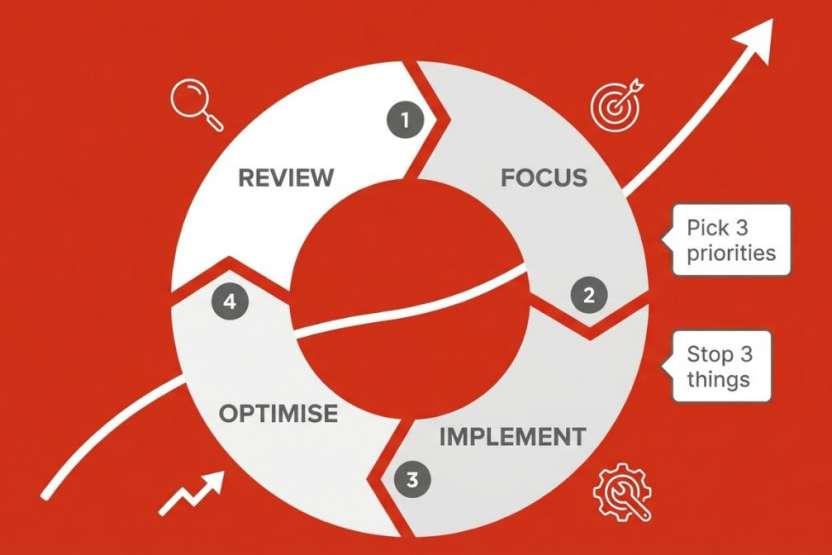
Build a short evidence pack, generate 3–5 routes with forced trade-offs, run a decision gate, then commit to a 90-day plan with three priorities and a tight learning loop.
How do we reduce hallucinations and wrong assumptions?
Require sources for “facts”, separate evidence from assumptions, validate with customer data and pipeline reality, and use a red-flag checklist before committing budget.
Can we do this without a full-time marketing director?
Yes, if someone senior can own the decisions. Many SMEs use fractional leadership or focused strategic support to set direction, governance, and a 90-day execution plan.
A final thought (and how we can help)
AI planning tools aren’t replacing strategic thinking. They’re raising the standard. SMEs that win will use AI for speed, while keeping humans accountable for direction, judgement, and governance.
If you want help turning AI drafts into a strategy your team can actually execute, Epitomise provides senior, practical strategic marketing leadership.
Accelerate Your Growth with Exceptional Strategic Marketing. With our proven Transform Accelerator Growth Framework, clients typically see 25% more qualified leads and faster sales cycles inside 90 days. We provide Expert-Led Strategy Creation, On-Demand Leadership, Mentoring, Training & Execution.
Explore Fractional CMO Support Request a Free Quote
Sources referenced
External sources open in a new tab.
- Gartner (Feb 2025) on GenAI adoption in marketing: Read on Gartner
- McKinsey on the economic potential of generative AI: Read on McKinsey
- OpenAI on why language models hallucinate: Read on OpenAI
- TechCrunch (Apr 2025) report on reasoning models hallucinating more: Read on TechCrunch
- WFA on brand concerns about agency use of genAI: Read on WFA
- UK ICO guidance on generative AI and data protection: Read on ICO
- European Commission: AI Act enters into force: Read on the European Commission
Like this? Share it!
About Epitomise:
We help SME and Technology companies use modern marketing strategies to grow. From strategic advice to tactical execution grow your business with the support of a 'top-100' award-winning marketing leader who is supported by a network of expert marketing specialists. With over 20-years' senior marketing experience and a track record of delivering results, as an attentive expert strategic marketing and services company, we help you grow your brand, leads, sales and customers by doing the right things the right way. Help for as long or as short as you need.