
Marketing in uncertain times - Review your marketing 3Ms
What will the coming months bring for your business? Review your marketing 3Ms - Market, Message and Media - to develop your approach for the year ahead.

Strategy
Two simple management tools turn an honest audit of your business into a prioritised growth plan: a SWOT analysis and a business impact matrix. Used together they take about an hour. If you have never written a plan down, this is where to start.
Research by M3 Planning found that businesses with strategic plans are 12% more profitable. And of 26,000 start-up business failures examined by Vertek Solutions, 67% had no written plan at all. An hour of your time is a cheap way to be on the right side of both numbers.
The first tool is the one most people already know: Strengths, Weaknesses, Opportunities and Threats. It captures a company’s internal strengths and weaknesses, and considers the external opportunities and threats around it.
Done pragmatically, a SWOT lets you reflect quickly on the business and the market it operates in. You can complete one in about half an hour, although a comprehensive review of the external factors takes longer and may involve buying research.
When you complete a SWOT for your own business, be very honest and do not wear rose-tinted glasses.
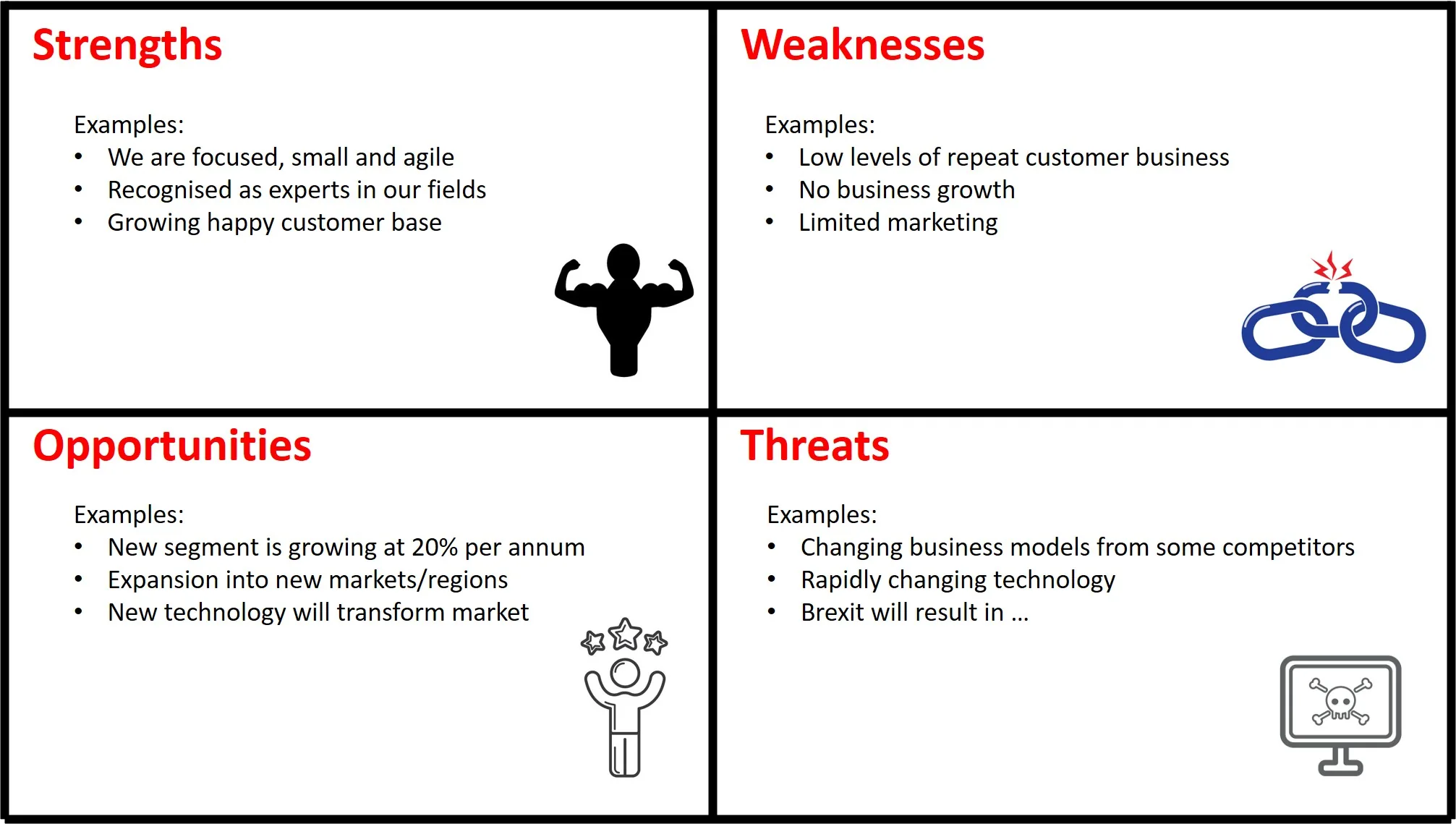
Take a piece of paper and draw a vertical and a horizontal line through the middle to make four rectangles. Name the top two Strengths and Weaknesses, and the bottom two Opportunities and Threats.
Start with your own company: its main strengths and weaknesses. Thinking about your products, price, place, promotion, people and processes will help you cover the ground.
Then look outward. Where are the main opportunities in the market, and are there major external threats? Think about market growth trends, competitors, changing customers, and the relevant PESTLE factors: political, economic, social, technological, legal and environmental. Do not forget changing business models. If you need to, spend some time researching your industry and your main competitors online.
Once everything is written down, leave it, make a cup of tea, and come back to it when you are in a reflective mood. Then read what it is telling you.
Start with the market opportunities. Which are genuinely exciting, and which are the top one to three? Are you focused on them? If you were, would your strengths support you, or would the weaknesses you listed hold you back?
Then the threats. Are any already hurting you, or capable of doing serious damage later? Our post on risks to small and medium businesses suggests pragmatic actions for avoiding them.
The value of this can be significant, and it may change what you do from tomorrow. A simple example: reflecting on your strengths and then reading your own website, you may realise your messaging does not mention your strongest attributes at all.
Finally, think about what you want the business to achieve, and use the SWOT to develop the strategies that will get you there. Leverage the key strengths, bridge the important weaknesses, exploit the attractive opportunities and defend against the threats that matter.
The second tool is a business impact matrix. Like the SWOT it is easy to use, and pragmatically it takes another half hour.
Once you have your candidate strategies, plot each one against two factors: how easy or hard it is to implement, and its net financial impact on the business.
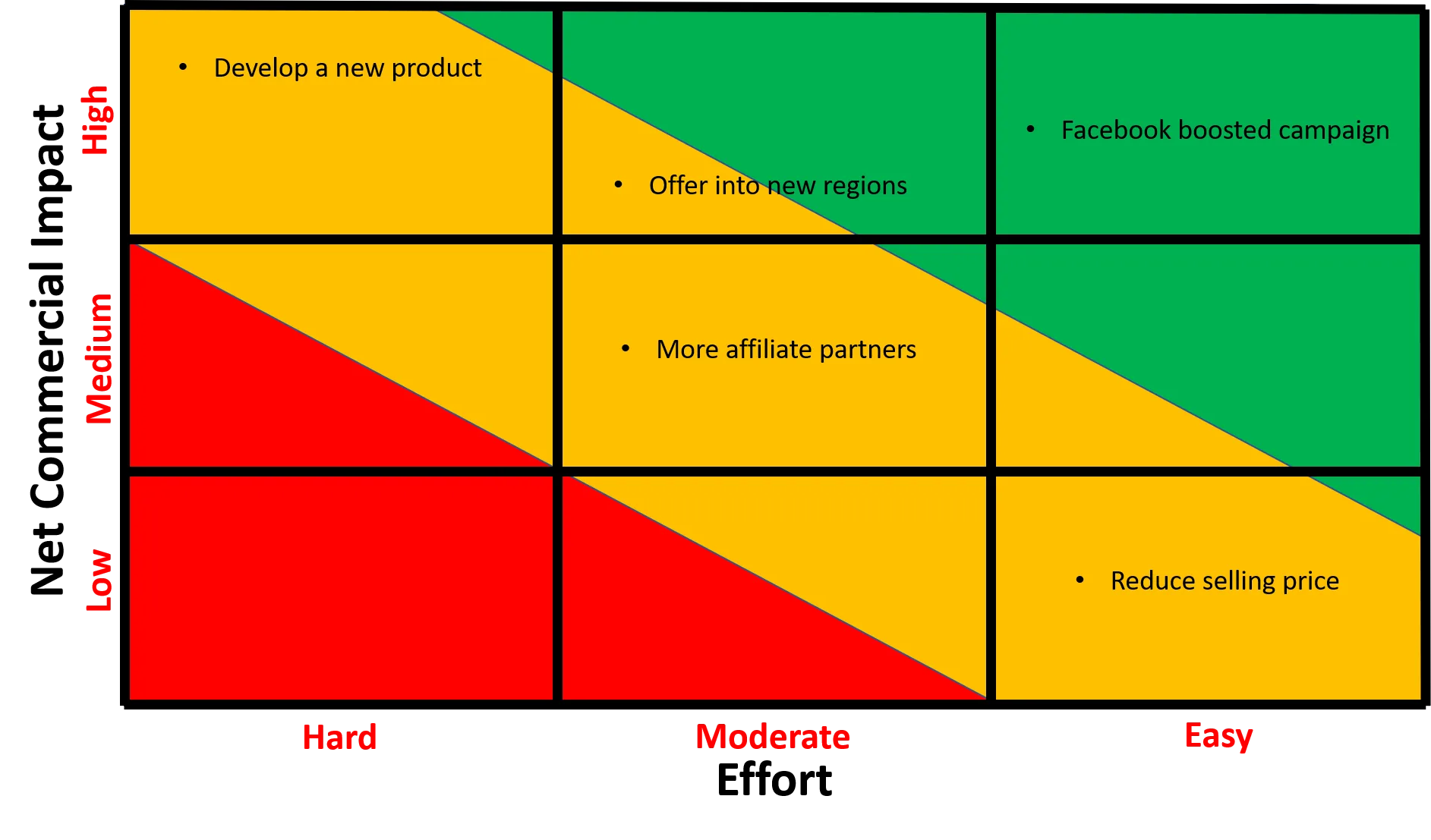
This lets you compare every strategy against every other and start with the ones that are easiest to implement for the largest impact. High-impact items that are hard to realise can be planned for when you have the resource and the budget. Items that are low impact and hard to execute can be forgotten.
The red, amber and green bands make the selection quick: drop the reds, hold the ambers for the medium term, start the greens now.
Once you have chosen your strategies, focus on implementation seriously and relentlessly. Writing the strategy is the easy half. Most organisations do not fall down on the analysis; they fall down on execution: research by Metrus Group found that fewer than 10% of all organisations successfully execute their strategy.
Best wishes with your SWOT, with prioritising your strategies, and with the focus both will give the business.
For more on developing winning business and marketing strategies, read 8 steps to strategic growth and Strategic marketing in 9 steps.
Who wrote this

Steve founded Epitomise in 2017 after UK, international and global marketing leadership roles, most recently as Global CMO of the Vitec Group’s Videocom Division. He works with SME and technology businesses on strategy, positioning and the execution that follows — more about Steve.
Read next
What will the coming months bring for your business? Review your marketing 3Ms - Market, Message and Media - to develop your approach for the year ahead.
Eight steps that turn a strategy into growth: choose the vital few objectives, resource them properly, own them, and communicate progress until the business believes it.
What is ‘strategic’ in strategic marketing? It’s defining and achieving business objectives by doing the right things in the right way through a considered and measured approach. Knowing where you want to be and having a prioritised and resourced plan to get you there using marketing best practices, competencies, tools and processes.
A short discovery call is usually enough to tell. No deck, no pitch.
Book a discovery call