ABM for UK SMEs including the use of AI
ABM for UK SMEs: how to run account-based marketing with a small team, and use AI for account research and outreach without losing credibility. Updated for 2026.

Operating rhythm
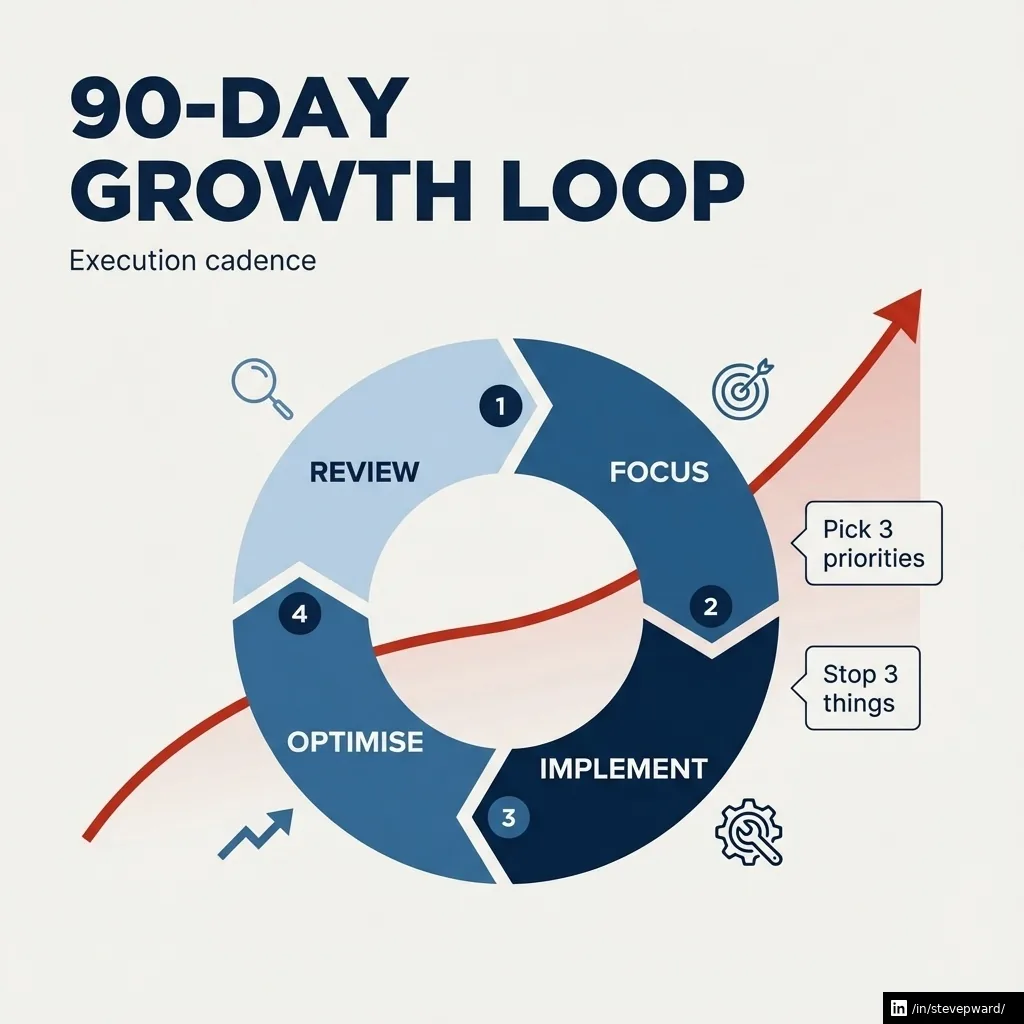
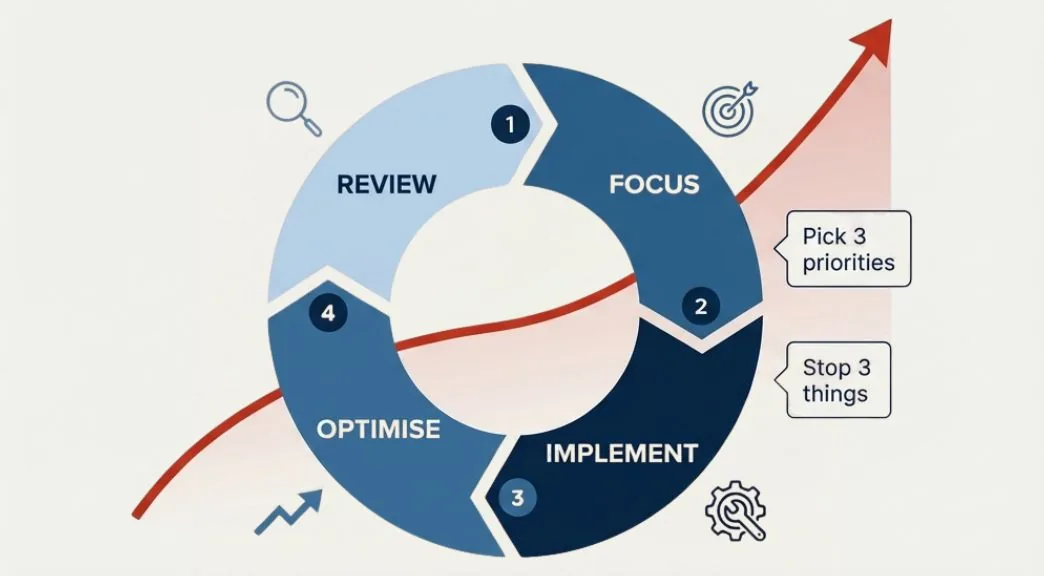
SMEs win growth by running marketing as a disciplined operating rhythm, not as a once-a-year planning exercise. The 90-day Transform Loop — Review, Focus, Implement, Optimise — turns strategy into shipped work and measurable pipeline, even when time, people and budgets are tight.
January looks tidy. February gets messy. March turns into “we’ll review next quarter.”
The core problem is not effort. It is cadence. SME marketing usually struggles because it tries to manage growth as a document rather than as an operating system: nothing repeats, so nothing compounds. Marketing Week has reported that most SMEs have no marketing action plan at all, and no plan usually means no rhythm.
When budgets are tight you do not get many chances to be wrong. MediaPost’s coverage of Gartner’s 2025 CMO Spend Survey reported marketing budgets flatlining as a share of company revenue. Whether you sit above or below that benchmark, the signal is the same: you cannot assume more budget will rescue weak prioritisation.
Annual and longer-term strategy still matters. It sets direction, constraints and the big bets. The problem is using the annual plan as the operating rhythm.
Run the 90-day loop without an annual guide and it becomes too tactical — you optimise activity instead of building advantage. Run annual planning without a 90-day cadence and you get tidy documents and messy delivery.
The answer is both. Strategy sets the where and why. The 90-day loop drives the what and now.
Timing matters. The loop is continuous, but to get the full impact you should complete Review and Focus before the quarter starts.
Goal: make decisions with evidence, not opinions.
What to review:
The output is one page: what we learned, and what we will change next quarter.
Goal: choose fewer bets and fund them properly.
Make three decisions:
Then decide one primary KPI — pipeline created, or qualified leads, or qualified meetings — three priorities for the quarter as the only funded bets, and three things you will stop so those priorities have oxygen. Sanity-check all of it against annual goals and positioning so the quarter stays directional.
Goal: ship weekly, not launch eventually.
Because Review and Focus happen in the runway, you start the quarter ready. There is no ramp-up quarter; you begin Day 1 shipping. Set a weekly cadence:
Most SMEs do not need more ideas. They need fewer projects that actually get finished.
Goal: improve results without increasing workload. Three rules keep you honest:
A simple optimisation list: tighten the messaging on the money pages; add conversion tracking where it is missing; improve lead response time and handover; build one reusable proof asset such as a case study, benchmark or set of pricing drivers; and remove friction by shortening forms, clarifying calls to action and cutting steps to enquiry.
You can run this without creating a big document. Each quarter, write down:
That single page is the plan. If it does not fit on the page, it will not fit in the quarter either.
It matches how real constraint works: limited time, limited people, limited budget. And it forces the thing most teams avoid, which is saying no.
If most SMEs have no action plan, the answer is not a bigger plan. The answer is a plan you can execute, measure and repeat every 90 days. Run the runway before Day 1, run Implement and Optimise for the full 90 days, then repeat one to two weeks before the next quarter begins.
Who wrote this

Steve founded Epitomise in 2017 after UK, international and global marketing leadership roles, most recently as Global CMO of the Vitec Group’s Videocom Division. He works with SME and technology businesses on strategy, positioning and the execution that follows — more about Steve.
Read next
ABM for UK SMEs: how to run account-based marketing with a small team, and use AI for account research and outreach without losing credibility. Updated for 2026.
Where AI genuinely helps with marketing strategy and where it quietly misleads. A practical workflow for UK SMEs, updated for 2026 with what changed when AI started doing its own research.
How UK SMEs can use AI across the whole buyer's journey, from discovery to decision, with 2026 evidence on what has actually changed. Includes where Claude Cowork and Claude Code fit for a small team.
A short discovery call is usually enough to tell. No deck, no pitch.
Book a discovery call