The Role of AI in Strategic Marketing Planning
Where AI genuinely helps with marketing strategy and where it quietly misleads. A practical workflow for UK SMEs, updated for 2026 with what changed when AI started doing its own research.

AI
AI lets SMEs scale marketing by automating content creation, deepening personalisation and improving campaign performance. From AI-drafted articles and video to smart email, chatbots and predictive ad tools, a small business can compete more effectively at every stage of the buyer’s journey. That holds as long as the strategy underneath it is clear.
The Office for National Statistics surveyed 38,637 businesses in June 2026 and found 35% of UK businesses with ten or more employees using at least one AI technology, up from around 12% in late 2023. The gap is the part worth looking at. Among businesses with 250 or more employees, adoption runs at 49%. Among those with fewer than ten, it is 28%.
So the picture is not that small businesses are ignoring AI. Most of the tools are free or nearly free and adoption has tripled in under three years. The picture is that larger competitors are roughly twice as likely to have it running in the business, and that gap compounds quietly.
ONS also found that 41% of businesses with ten or more employees reported no barriers to adoption at all. Where barriers did exist, the most cited was lack of expertise rather than cost, which affected somewhere between 7% and 14% of businesses depending on size.
Which is the honest version of this article’s argument. The obstacle for a small business is rarely the price or the access. It is knowing what to point it at. The risk is spending a year using AI to write social posts while a competitor quietly rebuilds how the work gets done.
Something changed in the last year that is easy to miss if you have only used these tools for writing. They will now do the work rather than describe it. Ask a question and an assistant will go away, read fifty sources, follow up on what it finds, and come back twenty minutes later with a referenced document. Give it access to a folder and it will read and write the files in it and finish the job.
That is the shift worth planning around, and it changes what AI is useful for at every stage below.
In this environment, strategic clarity becomes more critical, not less. Clearly defining goals is what lets AI support rapid, intelligent execution rather than generating volume for its own sake. With that strategic frame, SMEs can deepen their marketing impact, differentiate, and capture the attention of increasingly discerning audiences.
Significant change is underway across the whole company-to-customer journey.
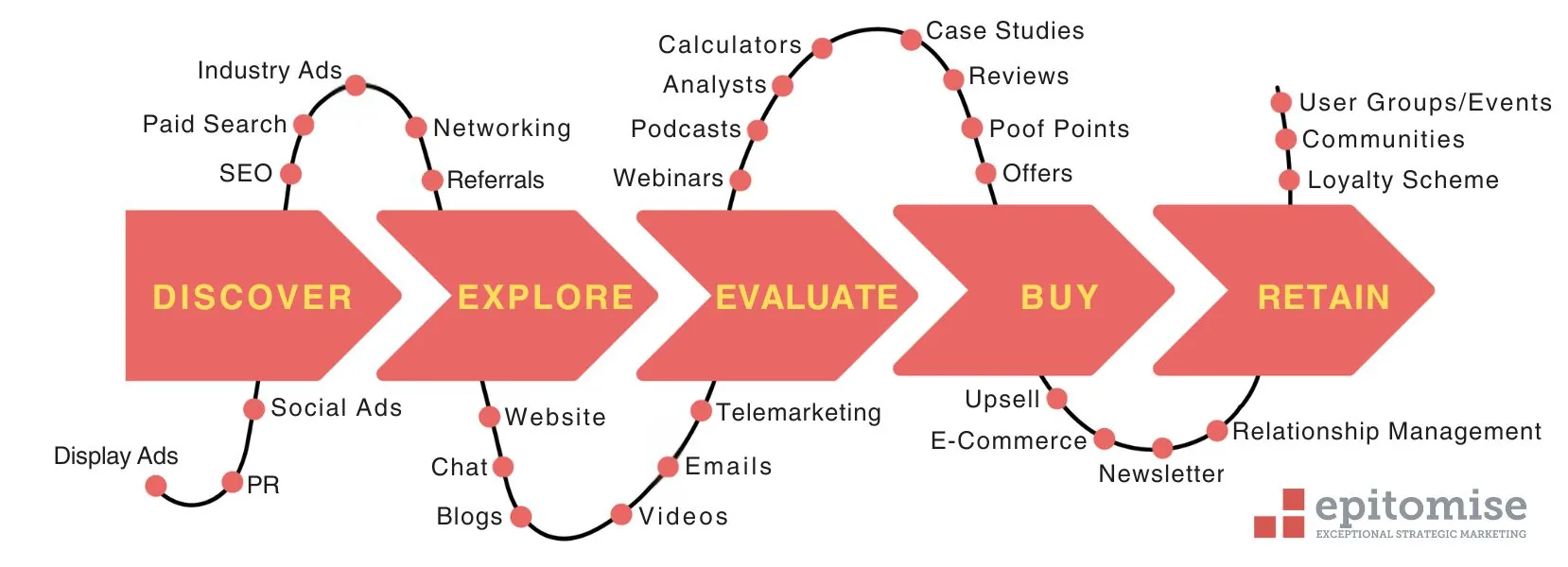
The first answer your buyer sees is increasingly generated rather than found, as decision-makers and influencers begin their search in an AI chat tool rather than a traditional search engine. That shift demands SMEs adapt quickly to avoid declining visibility and diminishing returns.
Pew Research tracked the actual browsing of 900 US adults across 68,879 Google searches. When an AI summary appeared, people clicked through to a result 8% of the time, against 15% when there was no summary. Only 1% clicked a link inside the summary itself, and sessions ended outright 26% of the time rather than 16%. That is US data from March 2025, so treat the exact numbers as a direction rather than your own.
In B2B the same shift shows up on the buyer’s side. 6sense surveyed nearly 4,000 buyers and found 94% now use large language models somewhere in their buying process, mostly to synthesise and organise research. Gartner’s 2026 survey of 645 buyers found 45% used generative AI primarily to gather information on vendors and products.
This does not mean publish more. It means publish differently. Being one of ten blue links is a shrinking prize. Being the source an assistant quotes when it answers your buyer’s question is a growing one, and it rewards the opposite of what content marketing usually produces: specific answers, real numbers with dates, a clear position. Vague thought leadership does not survive being summarised.
The clearest illustration is HubSpot, a company widely regarded as one of the best content marketers in the world. Its organic search traffic fell sharply over the same period that AI-driven search alternatives rose. SEMrush data showed HubSpot going from over 17 million organic visitors a month on 9 September 2024 to just over 4 million on 3 September 2025, a 77% decline in a year. If content marketing at that standard can lose three quarters of its organic traffic in twelve months, the shift is not something a smaller business can wait out.
There is a second effect. A number of SEO agencies are using AI to build detailed prompt libraries, auditing the market for competitors performing best against target keywords, then using the skyscraper technique with AI writing tools to rewrite optimised articles at volume. You can often see it in the sudden increase in the volume and depth of a blog. When many companies do this at once, the sheer quantity of content dilutes the impact of blogging as a way to support content marketing and search. That dilution is part of what the HubSpot numbers above are showing.
SMEs therefore need approaches that stand out in the middle of content saturation, rather than approaches that add to it.
Generative tools such as ChatGPT, Gemini, Claude, Copilot, Perplexity and Grok let marketers create tailored articles and social content quickly, improving both consistency and output without additional staffing. The general rule is quality in, quality out: a well-constructed prompt can take hours to engineer.
Visual storytelling matters more than ever, and image tools such as MidJourney and ChatGPT’s own image generation let SMEs generate customised graphics from text prompts, visualising a marketing concept or producing promotional visuals without a graphic designer, at lower cost and faster. Tools like Napkin AI turn text into diagrams and process flows.
Video is changing in the same way. Traditionally, high-quality video needed time, budget and technical expertise that many small businesses do not have. Tools such as Synthesia and Arcads turn text into presenter-led video for education and promotion, and text-to-video tools including Sora and Gemini’s video models generate footage from a written prompt. Podcast-style audio can be produced from text with tools such as ElevenLabs. One caution: check that pricing matches your expectations. If you plan hours of video a month and want colleagues involved in production, the cost can become significant.
AI is also embedded across the advertising platforms. Whether you use Google, Microsoft, Meta or another platform, generative and predictive AI now shapes audience selection, creative and placement. Care is needed to give the platform enough detail to tell good from bad. If an ad platform believes more leads is better, because it has no closed loop to what quality means for your business, it will double down on volume even as quality suffers, a pattern often seen with Performance Max campaigns.
Introducing a closed loop to your actual orders, by connecting your sales pipeline system, helps the platform understand what is genuinely performing. On Google Ads, enhanced conversions for leads is one way to achieve it.
Here is the part that is genuinely new, and it uses something you already own. Every enquiry email, call note, proposal question and review you have collected over the years is a record of what your buyers actually want to know. Almost no small business has ever analysed it, because reading four years of correspondence was never a realistic afternoon.
It is now. Point Claude Cowork, an AI assistant that works directly in the files and folders you already have rather than in a chat window, at that folder and ask it what people keep asking, which objections recur, and which questions your website does not answer. Because it can read the lot rather than one pasted email at a time, you get a content plan built from your own customers rather than from a keyword tool’s guess about them. That is a better brief than any competitor analysis, and nobody else has your version of it.
One finding should change how a small business spends its middle-of-funnel effort. 6sense found the eventual winner was already on the buyer’s day one shortlist 95% of the time, and the first vendor a buyer spoke to went on to win 77% of the time. Buying cycles shortened from 11.3 months in 2024 to 10.1 months in 2025, and first contact moved earlier, from 69% of the way through the journey to 61%.
Most of the contest is decided before anyone fills in your form. Nurture built on the assumption that you are educating an undecided buyer often arrives after the decision has already been framed.
That narrower window is exactly where AI-driven personalisation earns its keep. Generic messaging no longer suffices, and SMEs can produce targeted email using custom GPT-driven assistants that tailor content to behaviour and preference, which lifts open rates, click-through and eventually conversion.
Chatbots built on generative platforms transform engagement further. An intelligent virtual assistant gives prospects instant, accurate answers to complex questions and keeps potential buyers engaged rather than bouncing.
In the tech sector, SMEs use AI to create personalised, high-impact content without large teams. Platforms such as HubSpot AI and custom GPTs tailor emails, proposals and landing pages to behaviour and industry. Tools like Jasper and MarketMuse help optimise technical content for niche audiences, while outreach on LinkedIn is supported by AI-assisted drafting. The result is faster, sharper content that speaks to the prospect’s actual needs.
Research tools such as Elicit give SMEs rapid access to quality market insight, summarising academic research and structured data to identify emerging trends. An SME launching a cybersecurity service, for instance, can validate its campaign messaging and positioning against properly researched insight, which strengthens credibility.
There is an opening in the same data. 6sense found 58% of buyers went to a seller earlier than they wanted to, specifically to clarify things AI had left unclear. So the asset that earns its place in 2026 is not another explainer. It is the page that answers what an assistant fudges: what it costs, what it does not do, who it suits badly, how long it really takes, what happens when it goes wrong. Those pages are uncomfortable to write and they are the ones that convert, because the buyer arrives already half-informed and looking for the catch.
Two things make that practical for a small team. Cowork can research thirty target accounts to the standard you currently manage for six, working through them in one go and producing a brief on each. And if your website lives in a code repository, Claude Code, Anthropic’s equivalent tool for a codebase rather than a folder of documents, can build and publish those pages directly: it reads the whole project, makes the changes across every file that needs them, and takes it through to a review. Website changes stop being a queue you wait in and start being something you brief on Monday and see on Wednesday.
At the bottom of the funnel, AI transforms historically cumbersome tasks: proposal creation, follow-up and buyer analytics. Generative tools produce customised, professional-quality proposals tailored to a client’s specification, cutting response times from days to hours. That responsiveness increases the probability of closing by maintaining momentum.
AI-powered CRM platforms such as HubSpot AI and Salesforce Einstein prompt timely, personalised follow-up so leads stay engaged and sales cycles shorten. Conversation intelligence tools give sales teams insight into client concerns and priorities during calls, so representatives can address objections proactively and refine how they negotiate.
Multimedia tools extend the same advantage. Synthesia lets SMEs create personalised video presentations with AI-generated presenters, useful for explainers, demos and targeted pitches. ElevenLabs provides expressive AI voiceover for podcasts, promotional video and interactive audio, expanding audio marketing without high production cost. Call +44 (0) 121 724 0447 to hear one example of how AI voice can support a sales process.
The instinct at this stage is to automate the moment, and it is worth checking against what buyers actually say they want. Gartner’s May 2026 survey found 67% of B2B buyers prefer a rep-free experience and 70% want a fully digital, self-service purchase. Read those two figures alone and you would automate the lot.
The same survey found 69% prefer to validate what AI told them with an actual person, and 51% think they are more likely to be misled by an AI assistant than by a salesperson. Buyers want to run the process themselves, and then they want someone to confirm the answer before they commit. McKinsey’s 2026 research adds the cost of failing that moment: inconsistent information across a company is the single most common reason buyers switch suppliers.
For a small business this is a good position to be in, and AI helps you hold it rather than replacing it. Give Cowork your pricing, your terms, your scoping notes and your past proposals, and it drafts from what is actually true rather than from whatever the last person remembered. The website, the proposal and the person on the phone say the same thing. You cannot outspend a larger competitor on automation, and you can beat them on being consistent and reachable, which is what the buyer is testing for at this point.
AI now influences marketing across the whole buyer’s journey. The illustration below summarises how it affects each strategy along a possible route from first contact to loyal customer.
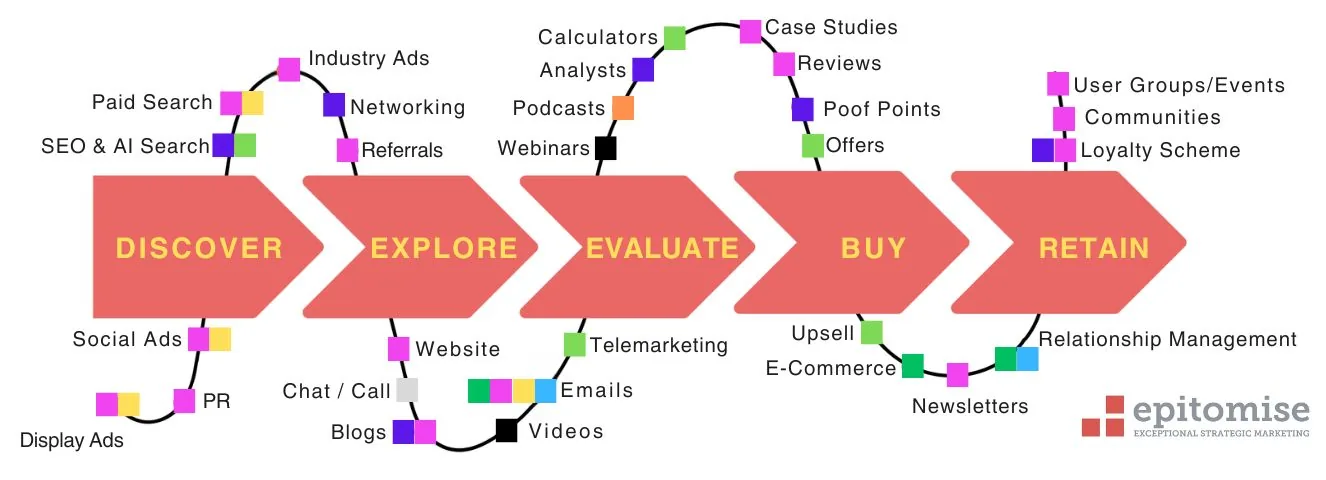
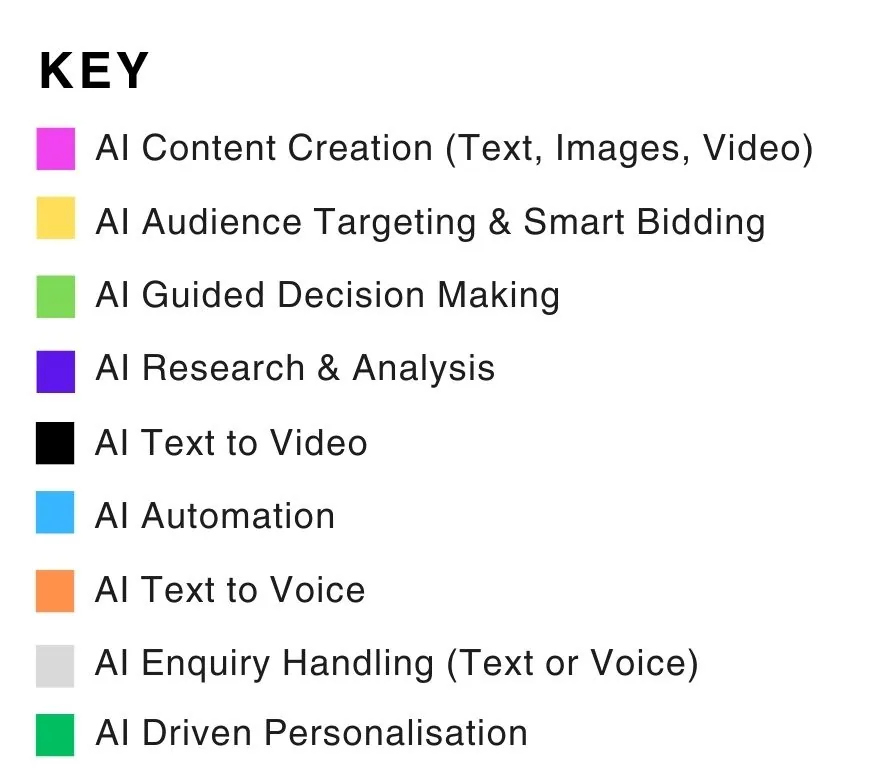
Each capability in the key does a specific job:
AI can improve the journey from company to loyal customer. It is also accelerating something broader: individual AI agents mapped to your wider company processes, able to take action without human intervention. Combined, agents connect one process to another digitally, retrieving and entering data, processing it, and handling customer enquiries alongside your existing systems.
AI agents should not be confused with AI-driven workflows. A workflow follows a script; agents decide their own process and can collaborate with other agents.
AI also improves the process of strategic marketing and business development itself. Platforms such as NotebookLM synthesise complex market research and competitor analysis into clear, actionable insight, helping SMEs formulate targeted strategies and responsive plans. Deep research modes within ChatGPT and Perplexity compress research that would once have taken several days.
The SMEs that proactively adopt AI across the journey do not just secure competitive parity. They position themselves to grow. That is exactly why the strategy behind the tooling matters more than the tooling itself.
The work that keeps customers is mostly the work that never gets done: the monthly report, the check on who has gone quiet, the follow-up nobody diarised. Cowork tasks can be scheduled to run on a cadence in the cloud, without your machine being on. The Monday report builds itself from the exports. A weekly pass over support tickets flags the accounts whose questions have changed tone. Renewal prep starts a month out because something remembered, not because someone did.
The two tools split the work cleanly. Claude Cowork connects to folders on your computer and to the systems you already use, then completes multi-step tasks in them. The distinction from ordinary chat is straightforward: in chat, Claude describes how to do something. In Cowork, it reads and writes your actual files and finishes the job, producing spreadsheets with working formulas, presentations, formatted documents and cleaned data. You approve what it does, with settings that range from confirming every action to letting trusted workflows run unattended. Claude Code does the equivalent job for a codebase rather than a folder of documents: it reads the whole project, makes changes across multiple files, runs commands, and takes a task through to a pull request, from a terminal, an editor such as VS Code, or the web. If your website lives in a code repository, that matters more to a marketer than it sounds, because content changes, landing pages, schema markup and tracking fixes all become things you can brief and review rather than queue behind a developer’s other work.
The pattern that works is to research and draft in Cowork, then hand the finished brief to Claude Code as a file and let it make the changes. You keep every decision. Each tool does the part it is actually good at, and both are included in Claude’s entry-level paid plan, which puts them within reach of a business of any size. Current pricing is on claude.com/pricing.
This article is an example of it. The research behind the figures above was done in Cowork, which read the existing piece, gathered the sources, checked each number against its original publication and wrote a brief. Claude Code applied that brief to this page. What went in and what stayed out was Steve’s call, and that was always going to be the part that could not be handed over.
One assistant and one workflow. Pick ChatGPT, Claude or Gemini, and apply it to the task that costs you the most time each week. ONS found the most cited barrier to adoption is lack of expertise rather than cost, so the decision that matters is which job to point it at and who will own it, not which tool to buy.
Three things worth knowing about. It will run its own research, spending twenty minutes across dozens of sources and returning something referenced. It will work directly with the files on your computer and finish a task rather than describing it. And it will read everything at once, so four years of enquiry emails becomes an afternoon’s analysis instead of a project nobody ever starts.
Thin content will, as it always did. The bigger shift is that fewer people click at all: Pew found clicks fall from 15% to 8% of searches when an AI summary appears. Write to be quoted rather than to rank, which means specific answers, real numbers, clear dates and a stated point of view.
In the UK there is no law requiring it. The Advertising Standards Authority expects you to say so where hiding it would mislead a buyer or change their decision. The line worth holding is simpler than any rule: nothing a machine generated should ever be presented as something a person saw, said or checked. Invented case studies and fabricated testimonials are the real risk, and they cost you the client.
It replaces the drafting, not the deciding. AI will produce a competent plan in minutes and it will not tell you which customers to walk away from, what to stop doing, or which of two credible routes fits the business you actually run. Those are the expensive questions, and they are the ones worth paying for.
Less than most owners expect. The main assistants have capable free tiers, and the paid plans that include agentic tools like Cowork and Claude Code start at the entry-level subscription. Current pricing is on claude.com/pricing. The real cost is the few hours of attention it takes to redesign one workflow properly.
Who wrote this

Steve founded Epitomise in 2017 after UK, international and global marketing leadership roles, most recently as Global CMO of the Vitec Group’s Videocom Division. He works with SME and technology businesses on strategy, positioning and the execution that follows — more about Steve.
Read next
Where AI genuinely helps with marketing strategy and where it quietly misleads. A practical workflow for UK SMEs, updated for 2026 with what changed when AI started doing its own research.
ABM for UK SMEs: how to run account-based marketing with a small team, and use AI for account research and outreach without losing credibility. Updated for 2026.
Run marketing as a repeatable quarterly cycle — Review, Focus, Implement, Optimise — so strategy turns into shipped work and measurable pipeline.
A short discovery call is usually enough to tell. No deck, no pitch.
Book a discovery call