Content marketing for business results - Content is king
If you approach content marketing with a clear strategy, you can run a highly scalable and successful content marketing campaign. Here is the process to follow.

Content marketing
A high-quality piece of content takes real effort to produce, and most of it is published once and left behind. Decide how an asset will be reused before you create it, and the 13% to 26% of a marketing budget that content consumes, on 2020 figures, starts earning its keep.
Businesses typically spend between 5% and 15% of revenue on marketing. At the time this was written in 2020, The CMO Survey put the average at 9.8% of revenue, with B2C service companies devoting 15.6% and B2B product companies 8.6%. Gartner’s CMO survey showed similar numbers, with marketing expense budgets at 10.5% of company revenue.
Content marketing then takes a significant proportion of that spend. B2B Content Marketing research put the average spend on content at 26%, while Salesforce research put it at 13% in B2B and 19% in B2C. Those figures are from 2020 and the percentages will have moved since, but the order of magnitude is the point: with somewhere between 13% and 26% of the marketing budget going on content, what you create has to be worked hard and leveraged across different marketing activities.
If you are to maximise the return on your investment in content, every piece needs to be carefully considered. What are its objectives? How will its success be measured? How will it be used, and how will it be repurposed, so that it returns the cost of creating it?
Take a zero-based marketing approach: every item that has money spent on it must give a positive return on that spend.
Quality, high-impact content — whitepapers, eGuides, blogs, websites — takes significant effort to create if it is going to deliver results in a noisy, competitive communications environment.
A well-made eBook or whitepaper takes research, writing, design, review, adjustment and publication. In B2B Content Marketing’s research, 62% of B2B marketers said eBooks and white papers were the most successful types of content they produce — and that quality is exactly why they cost what they do. A well-written, cross-linked blog that performs in search is likely to exceed 2,000 words, and again takes time to produce.
If you have eGuides, whitepapers or quality articles, ask how long they took to produce and at what cost. Once published, did they earn their keep and deliver the results you expected? It is all too common to see relatively costly assets created, published and then abandoned in favour of the next one.
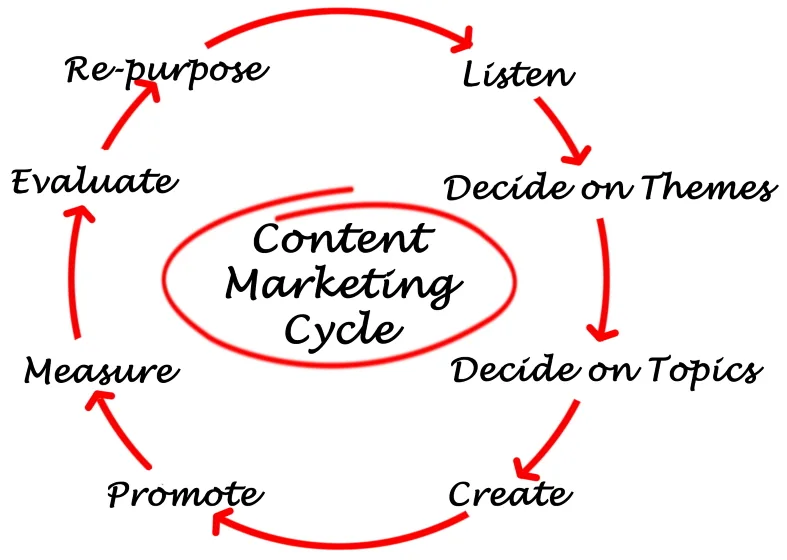
When you put significant effort into creating quality content, get the most return from that effort. Primary content, or sections of it, can be repurposed in many ways: input into customer and internal presentations, slide decks, video storyboards, letters, newsletters, webinars, podcasts, infographics, and multiple social posts.
Your 2,000-word article might feed three or four social posts, become the foundation of an email sequence, and form a section of your next eGuide. You might also use the same words differently — as a visual infographic, or an animated video.
Your website presents your value propositions, usually structured as the problems you resolve, your solutions to those problems, the value of those solutions, and the proof points that support what you say. If you are presenting that value proposition elsewhere, such as in a new client presentation, the slides can start with and build on your website content. At the end of the meeting you may want to leave or send a company overview brochure — and that too can be assembled from the relevant areas of your website.
A considered content roadmap supports your marketing aims. If you are creating content to support demand generation, look at where businesses see real value in their content and weight your roadmap accordingly — the Content Marketing Institute’s demand generation content research is a reasonable starting point.
When reflecting on your content, consider what your target audience actually wants to hear. It is likely to be something that resolves their problems and adds real value to them today or in the near future.
How will that content reach them? Many factors influence the choice of marketing channel. Our article on selecting the right communication channels covers this in more detail.
Personalisation of content can be very productive when technology supports it.
A good example is a personal, unique PDF generated for any company auditing its marketing and growth strategy through our online assessment tool. The assessment asks a set of easy-to-answer questions, and everyone who completes it immediately receives a detailed personalised report that scores their approach and suggests improvements based on their answers.
The whole process is automated. Content is reused and repurposed over and over, and made unique each time. Each question has three possible answers, and the wording behind every one of those options is already written and stored in a spreadsheet. When the questions are answered, a score is calculated automatically and the personalised report is sent. You can try the assessment yourself.
When writing emails, consider how they can serve future subscribers too by including them in triggered nurture tracks.
If you post consistently on social media, posting tools that archive your posts are extremely valuable for storing and rapidly adjusting content to use again later. They also let you post the same content across multiple platforms simultaneously.
Writing high-quality marketing content takes time, and time is money — so is syndicating your content a good idea or a bad one?
If you write an article for your website and then post the same article elsewhere, for example as a LinkedIn article or on a third-party blog, that is syndicated content.
If you want to work your content across as many relevant channels as possible, and outranking the other site organically is not important to you, then syndication is likely to be a good idea.
If you want your content to perform for SEO, duplicating it across other sites is likely to be a bad idea — unless you are careful and secure permission from the third-party site to use canonical tags or NoIndex. Canonical tags tell search engines that you are the original source. NoIndex tells them not to index a page. If the third-party site will not do either, ask for clear attribution and a backlink to your website. On LinkedIn you will not be able to add either to republished content.
What are the objectives for your content? Do you syndicate, and have you seen results? If you want further reading, Neil Patel has a useful step-by-step guide to syndicating content without damaging your SEO.
Content used at the bottom of the funnel, at the evaluate and buy stages of a company-to-customer journey, includes client case study videos, written customer references and product demos. Should those assets be reused at the top, during the discover and explore phases?
It is striking how often referral marketing programmes take a bottom-of-funnel video case study and use it as a top-of-funnel asset. Think about the journey: a new prospect is rarely going to sit through a three-minute video whose messaging is pitched at evaluation rather than discovery.
Creating referral content that supports discovery is a good idea. But the messaging and the content have to be built for people meeting your business for the first time. The same applies to the rest of your bottom-of-funnel content.

For help creating marketing content that supports real business results, contact us.
Who wrote this

Steve founded Epitomise in 2017 after UK, international and global marketing leadership roles, most recently as Global CMO of the Vitec Group’s Videocom Division. He works with SME and technology businesses on strategy, positioning and the execution that follows — more about Steve.
Read next
If you approach content marketing with a clear strategy, you can run a highly scalable and successful content marketing campaign. Here is the process to follow.
Anyone can publish content, but not everyone who publishes is a thought leader. Here are the essentials of creating thought leadership content that earns trust in your brand.
ABM for UK SMEs: how to run account-based marketing with a small team, and use AI for account research and outreach without losing credibility. Updated for 2026.
A short discovery call is usually enough to tell. No deck, no pitch.
Book a discovery call