What is A/B testing?
Learn what A/B testing means, how a controlled marketing experiment works and which mistakes make test results unreliable.

Marketing glossary
Conversion rate shows how often people or accounts complete an action you care about. The arithmetic is simple; deciding what counts as a conversion and which group belongs in the calculation requires more thought.
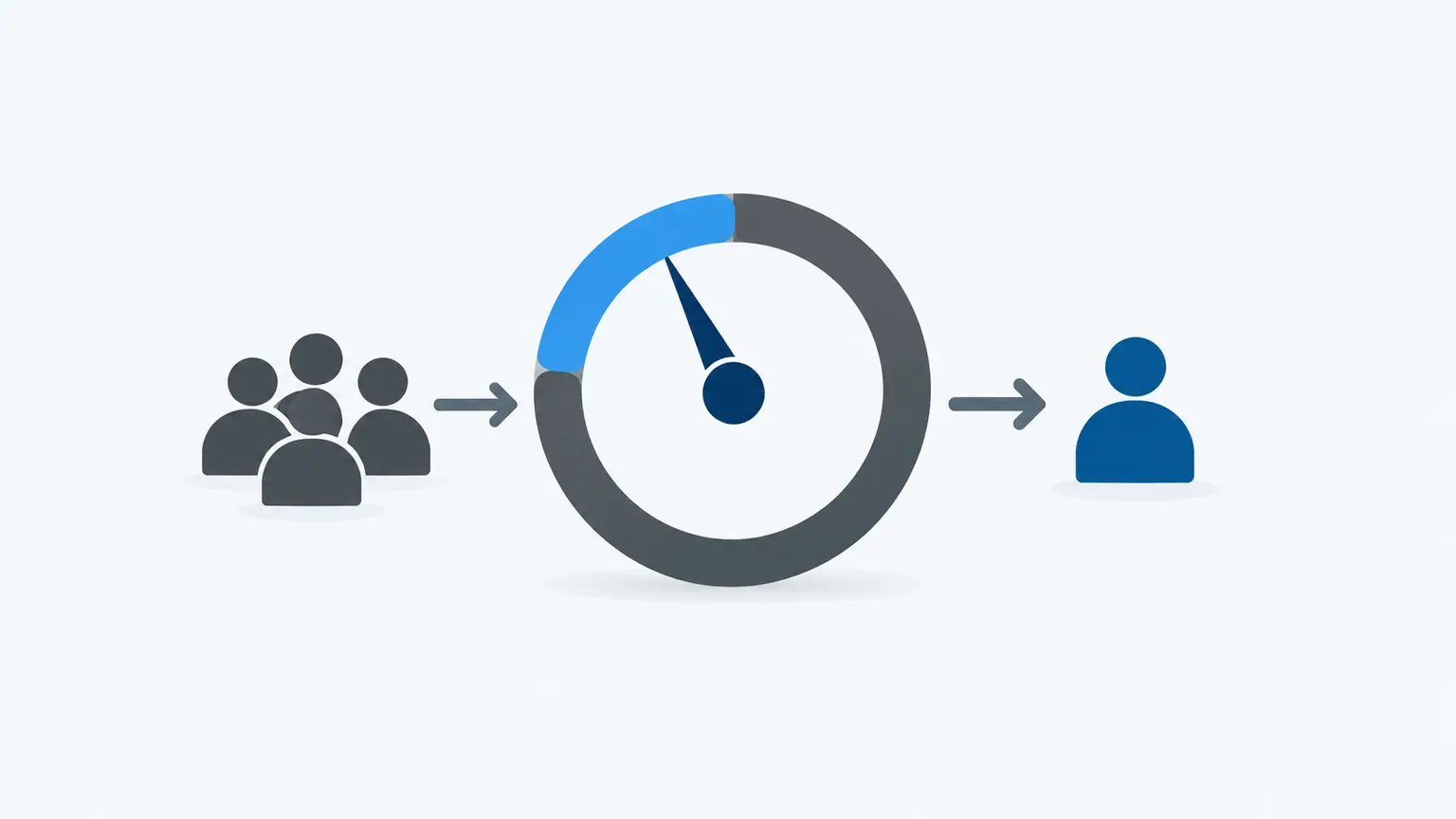
A conversion is any defined action that represents useful progress. An ecommerce shop may count a completed order. A consultancy might count a qualified enquiry rather than every form submission. A software business may measure the proportion of trial accounts that become paying customers.
The basic formula is:
Conversion rate = conversions ÷ eligible population × 100
If 25 of 1,000 landing-page visitors submit an enquiry, the visitor-to-enquiry conversion rate is 2.5%. If five of those 25 enquiries meet the firm’s qualification criteria, the enquiry-to-qualified-enquiry rate is 20%.
Naming both ends of the rate prevents confusion. “Our conversion rate is 20%” means little unless the reader knows whether it measures advert clicks, form submissions, sales opportunities or purchases.
A small training provider runs a campaign for a management workshop. The landing page receives 600 eligible visits and produces 30 registrations, giving a 5% visit-to-registration rate.
However, ten registrations use personal email addresses and do not match the intended business audience. If the commercial goal is qualified business registrations, the relevant result is 20 and that rate is about 3.3%.
Neither percentage alone explains performance. The provider should also examine traffic relevance, cost, attendance and whether registrations lead to worthwhile customer relationships.
Conversion rates help you locate friction within a marketing funnel. If suitable prospects click an advert but leave the landing page, the message, evidence, offer or form may need work. If qualified enquiries rarely become proposals, the problem may sit in qualification, follow-up or commercial fit instead.
Rates also allow fairer comparisons when volumes differ. Fifty conversions from 1,000 eligible visits and 40 from 500 represent different efficiency, although cost and customer value still affect which result is better.
Do not improve the rate by making the conversion easier but less valuable. Replacing a detailed quotation request with a prize draw may increase submissions while reducing commercial intent.
Use a consistent denominator and timeframe. Sessions, users and accounts are not interchangeable. A long B2B buying cycle can also make a monthly lead-to-customer rate misleading when this month’s customers first enquired in earlier periods.
Avoid applying an external “good conversion rate” without context. Channel, offer, audience, price, intent and definition all change the result.
Divide completed conversions by the eligible population and multiply by 100. State exactly what each figure represents.
Yes. It can result from lower-quality traffic, a less demanding action or heavy discounting. Judge it alongside qualification, cost, margin and eventual customer value.
Who wrote this

Steve founded Epitomise in 2017 after UK, international and global marketing leadership roles, most recently as Global CMO of the Vitec Group’s Videocom Division. He works with SME and technology businesses on strategy, positioning and the execution that follows — more about Steve.
Read next
Learn what A/B testing means, how a controlled marketing experiment works and which mistakes make test results unreliable.
Learn what answer engine optimisation means and how to make useful business content easier for search and AI systems to extract and cite.
Learn what bounce rate means, why analytics tools calculate it differently and how to diagnose a high bounce rate without guessing.
A short discovery call is usually enough to tell. No deck, no pitch.
Book a discovery call