What is A/B testing?
Learn what A/B testing means, how a controlled marketing experiment works and which mistakes make test results unreliable.

Marketing glossary
Customer acquisition cost tells you, on average, how much the business spends to win each new customer. The calculation becomes useful when its inputs are consistent and when you compare the result with the economics of the customers acquired.
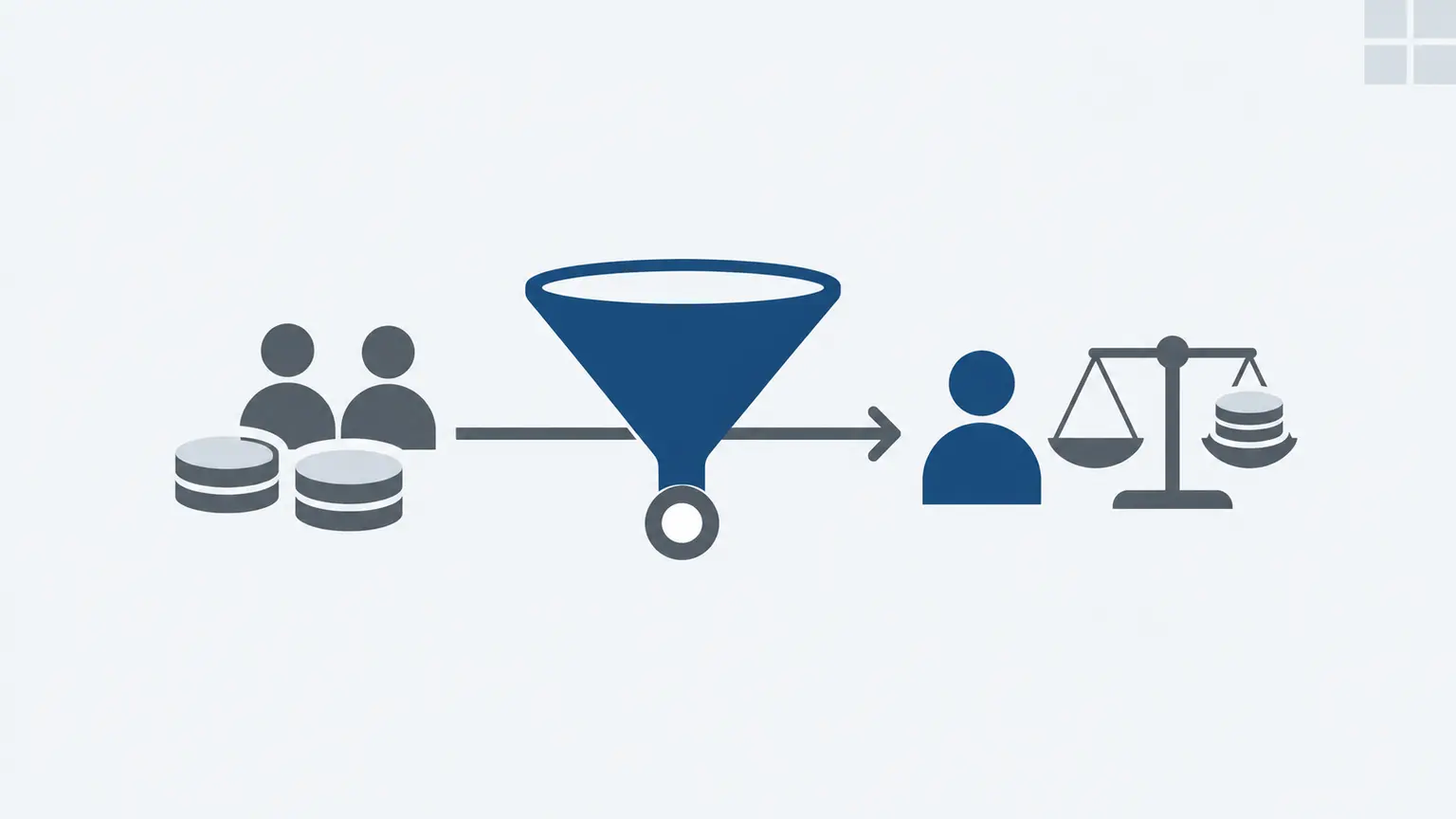
The basic formula is:
CAC = total sales and marketing acquisition costs ÷ new customers acquired
If a business spends £24,000 on acquisition during a quarter and wins 12 new customers, its blended CAC is £2,000.
The difficult part is deciding which costs and customers belong together. Acquisition costs may include advertising, events, agency fees, sales salaries, commissions, software and an appropriate share of campaign or content production. State what you include. A calculation based only on advertising spend can be useful for media analysis, but it is not the full cost of acquiring a customer.
A managed IT provider spends £9,000 on marketing and £15,000 on sales activity in a quarter. It signs 12 new support customers, producing the £2,000 blended CAC above.
Suppose four came through partner referrals and eight through marketing-supported direct sales. The company can explore costs by route, but attribution may not be clean: a direct customer might have read articles, attended an event and spoken with a partner before enquiring.
The £2,000 figure does not say whether the quarter was successful. A customer expected to contribute £10,000 in gross profit can support a different acquisition cost from one expected to contribute £1,500. The timing of that profit matters as well.
CAC helps leaders connect sales and marketing investment with commercial outcomes. It can inform budgets, pricing, market selection and the balance between acquisition and retention.
Tracking it by meaningful segment may reveal that one apparently productive channel attracts small customers who leave quickly, while another produces fewer but better-fit relationships. Blended figures are a starting point, not the end of the analysis.
Do not divide this month’s spending by customers who began their buying journeys last year and assume the result describes this month’s activity. Long sales cycles create a timing mismatch. Cohort analysis connects a group of customers with the investment that influenced their acquisition, although it requires better data.
Avoid reporting paid-media CAC and blended CAC under the same label. Write the scope beside the number, including timeframe, customer definition and included costs.
Do not judge CAC alone. Rapid acquisition can still strain cash if the business pays marketing and sales costs now but recovers them slowly.
Include the sales and marketing costs reasonably associated with acquisition, and document the boundary. Use narrower channel calculations as additional measures rather than quietly calling them total CAC.
There is no universal figure. It depends on gross margin, lifetime value, retention, cash flow, growth goals and payback time.
Who wrote this

Steve founded Epitomise in 2017 after UK, international and global marketing leadership roles, most recently as Global CMO of the Vitec Group’s Videocom Division. He works with SME and technology businesses on strategy, positioning and the execution that follows — more about Steve.
Read next
Learn what A/B testing means, how a controlled marketing experiment works and which mistakes make test results unreliable.
Learn what answer engine optimisation means and how to make useful business content easier for search and AI systems to extract and cite.
Learn what bounce rate means, why analytics tools calculate it differently and how to diagnose a high bounce rate without guessing.
A short discovery call is usually enough to tell. No deck, no pitch.
Book a discovery call