What is A/B testing?
Learn what A/B testing means, how a controlled marketing experiment works and which mistakes make test results unreliable.

Marketing glossary
A customer journey map shows what a customer is trying to achieve and what happens as they interact with your business. It connects moments that internal teams often manage separately, exposing gaps that no single department can see from its own dashboard.
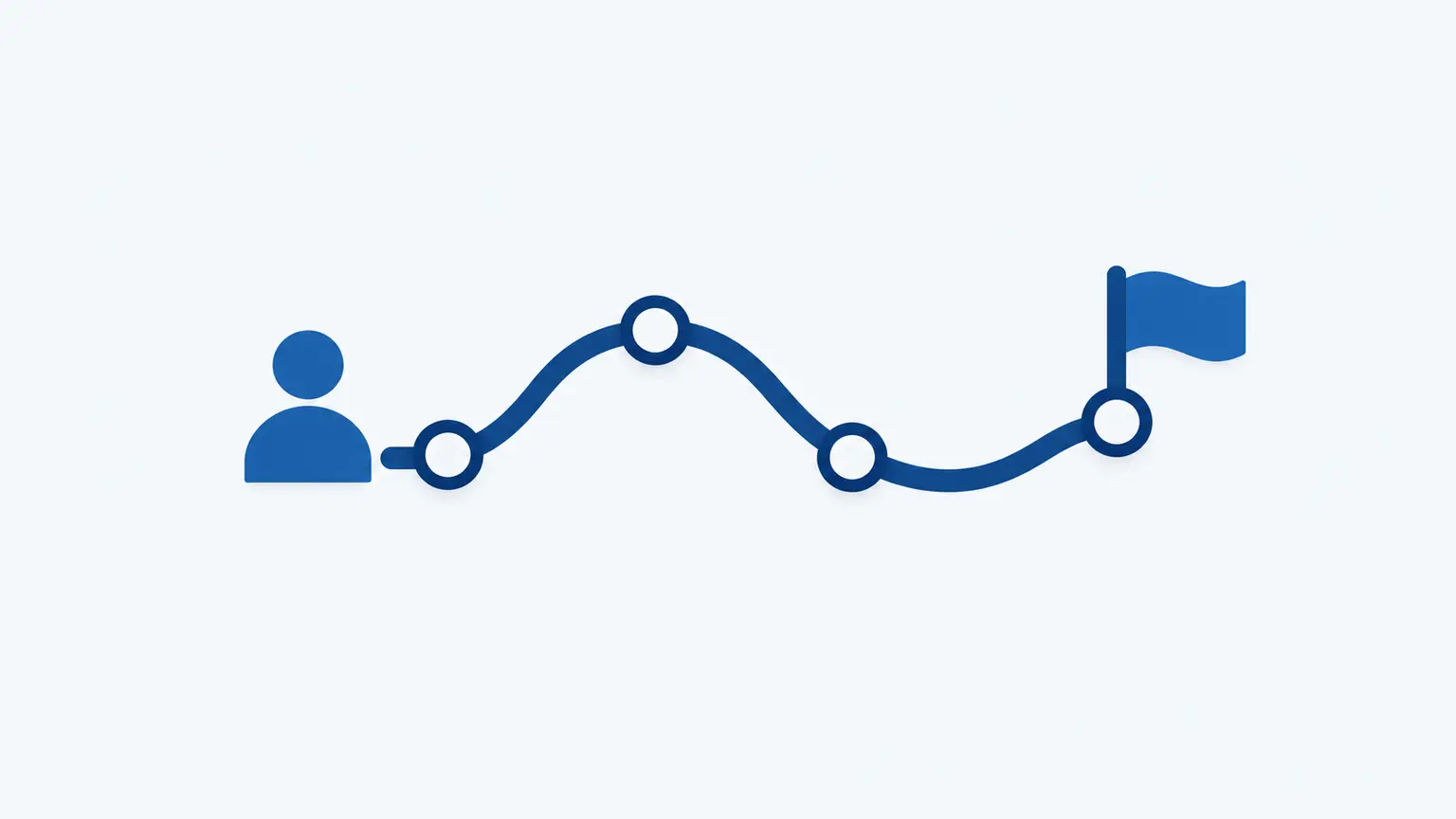
A journey map usually follows one customer type and one defined scenario across a sequence of stages. For each stage, it can record the customer’s goal, actions, questions, concerns, touchpoints and outcome. It may also show which team or system owns the interaction and what evidence supports the map.
The map should describe a real journey rather than the process the business wishes customers followed. Website analytics, customer interviews, sales notes, support records and observation can reveal detours and hand-off problems that a workshop diagram misses.
A customer journey differs from a marketing funnel. The funnel measures progression through business-defined stages. The journey map describes the customer’s tasks and experience, including loops, pauses and interactions after purchase.
Consider a small commercial cleaning company. A facilities manager may first notice inconsistent standards, ask colleagues for recommendations, compare suppliers, request a site visit, review a proposal, seek budget approval, arrange mobilisation and then manage the first month of service.
Mapping that journey could reveal that the proposal arrives promptly but gives finance no clear cost assumptions; the contract is then delayed despite strong initial interest. It might also show that mobilisation information sits across several emails, leaving the customer unsure who handles building access.
The useful actions are not necessarily “create more awareness”. They may be to add a one-page commercial summary to proposals and provide one mobilisation checklist with a named owner.
The map makes cross-team problems visible. Marketing can see which questions arise before an enquiry. Sales can see what customers need to build an internal case. Delivery can understand promises made earlier, while support can identify recurring friction that affects retention.
It also helps prioritise improvements. A long list of touchpoints is less useful than identifying the moments that create risk, confidence or delay.
Do not create one universal map for every customer and every goal. A first-time buyer evaluating a complex service has a different journey from an existing customer seeking support. Define the persona, situation and start and end points.
Avoid filling the map with invented emotions. If research shows that customers ask repeatedly about implementation, record that evidence. If the team merely assumes they feel “delighted” after a demo, label the assumption and test it.
At minimum: the customer and scenario, stages, goals, actions, questions, touchpoints, barriers and evidence. Add internal owners or measures only when they make the map more actionable.
No. It can map onboarding, service use, renewal, support or departure. Post-purchase journeys often reveal valuable retention improvements.
Who wrote this

Steve founded Epitomise in 2017 after UK, international and global marketing leadership roles, most recently as Global CMO of the Vitec Group’s Videocom Division. He works with SME and technology businesses on strategy, positioning and the execution that follows — more about Steve.
Read next
Learn what A/B testing means, how a controlled marketing experiment works and which mistakes make test results unreliable.
Learn what answer engine optimisation means and how to make useful business content easier for search and AI systems to extract and cite.
Learn what bounce rate means, why analytics tools calculate it differently and how to diagnose a high bounce rate without guessing.
A short discovery call is usually enough to tell. No deck, no pitch.
Book a discovery call