What is A/B testing?
Learn what A/B testing means, how a controlled marketing experiment works and which mistakes make test results unreliable.

Marketing glossary
A lead magnet gives a potential customer something useful before they are ready to buy. In return, the business may receive contact information and permission to continue the conversation. The exchange works only when the resource solves a real, specific problem.
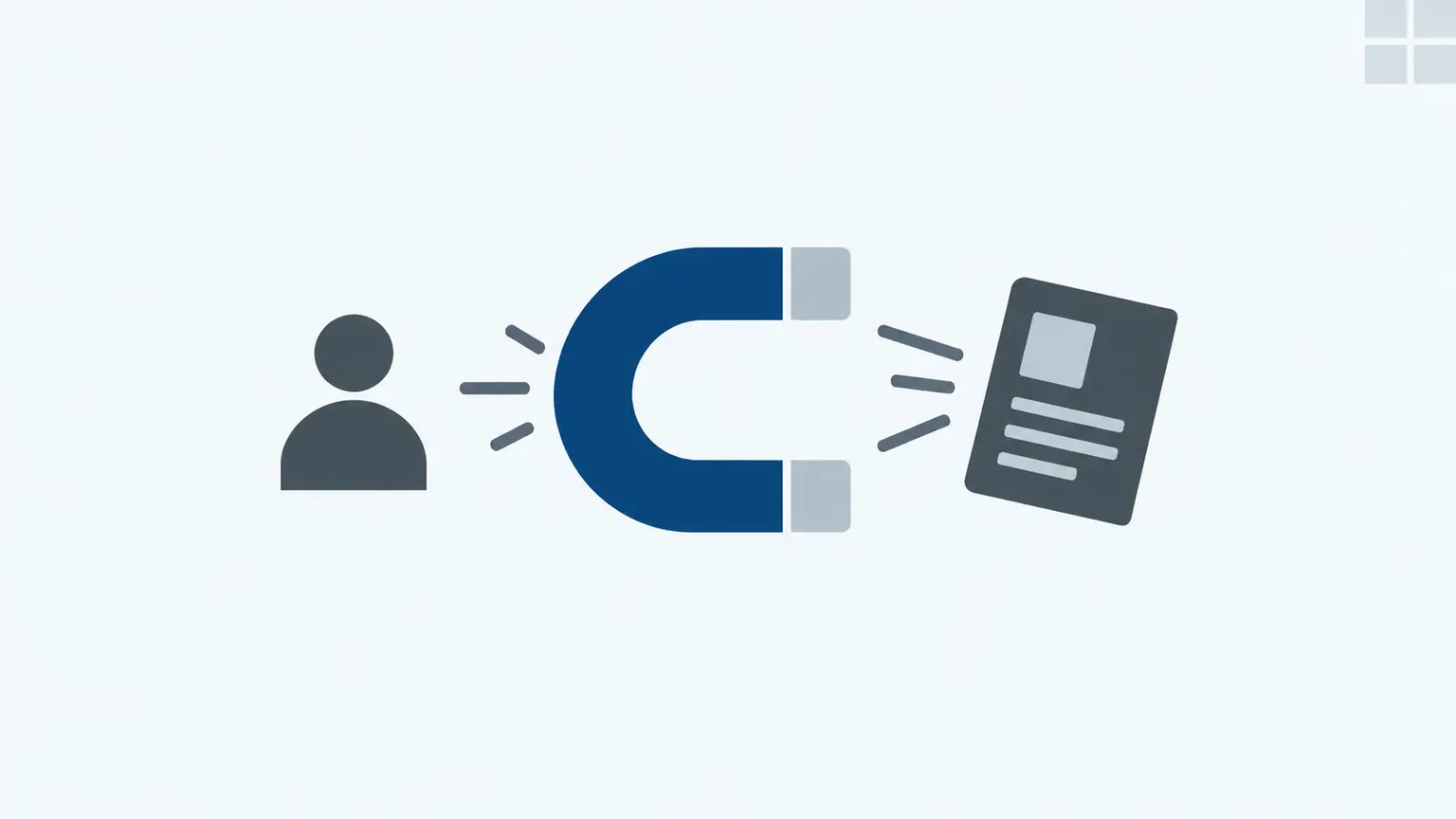
Lead magnets are often downloadable guides, but the category is broader. A checklist, template, calculator, benchmark tool, webinar, email course or self-assessment can all serve the same function.
The resource should connect naturally to the paid offer. A consultancy selling go-to-market planning might publish a launch-readiness checklist. That attracts people working on a relevant problem and gives the consultancy a sensible subject for follow-up. A generic prize competition may collect more addresses while revealing almost nothing about commercial need.
Some lead magnets are gated behind a form; others are freely accessible and invite the reader to subscribe or enquire afterwards. Gating is a commercial choice, not part of the definition.
Imagine a small HR consultancy serving businesses that are hiring their first managers. It creates a practical one-to-one meeting template with prompts for objectives, feedback and follow-up.
The landing page explains who the template is for, shows what it contains and asks for a name and business email address. The confirmation email provides the file and explains that the consultancy will send occasional management resources, with an unsubscribe route.
The consultancy should measure more than download volume. It could assess whether suitable firms download it, engage with later material and become qualified conversations. The template must be genuinely usable without withholding the important parts for a sales call.
A strong resource creates value at an early stage and lets the business build recognition over time. It can also reveal audience questions: repeated downloads, replies and follow-up behaviour show which problems deserve deeper content.
For a complex B2B sale, this is often more realistic than expecting a first-time visitor to book a call immediately. The lead magnet offers a lower-commitment next step while preserving relevance.
Do not create a long PDF simply because “ebooks generate leads”. Format should follow the task. A one-page checklist may be more useful than 30 pages of padded explanation.
Avoid treating every downloader as sales-ready. Someone may be researching, learning or collecting examples. Agree qualification criteria and use follow-up that helps rather than immediately handing the record to a salesperson.
Be explicit about the exchange. If you will use contact details for ongoing marketing, explain that clearly and handle consent, privacy and unsubscribe choices appropriately. Do not disguise a mailing-list registration as a supposedly free download.
Gate it when the value of appropriate follow-up justifies the added friction and the reader receives a fair exchange. Leave it open when reach, search visibility and easy reference matter more than collecting an address.
It addresses one recognisable problem, produces a useful outcome quickly, demonstrates relevant expertise and connects honestly to the next step the business can offer.
Who wrote this

Steve founded Epitomise in 2017 after UK, international and global marketing leadership roles, most recently as Global CMO of the Vitec Group’s Videocom Division. He works with SME and technology businesses on strategy, positioning and the execution that follows — more about Steve.
Read next
Learn what A/B testing means, how a controlled marketing experiment works and which mistakes make test results unreliable.
Learn what answer engine optimisation means and how to make useful business content easier for search and AI systems to extract and cite.
Learn what bounce rate means, why analytics tools calculate it differently and how to diagnose a high bounce rate without guessing.
A short discovery call is usually enough to tell. No deck, no pitch.
Book a discovery call