What is A/B testing?
Learn what A/B testing means, how a controlled marketing experiment works and which mistakes make test results unreliable.

Marketing glossary
A marketing funnel gives you a practical way to organise marketing around the progress a buyer needs to make. It is useful for planning and measurement, provided you remember that real people rarely move through it in a perfectly straight line.
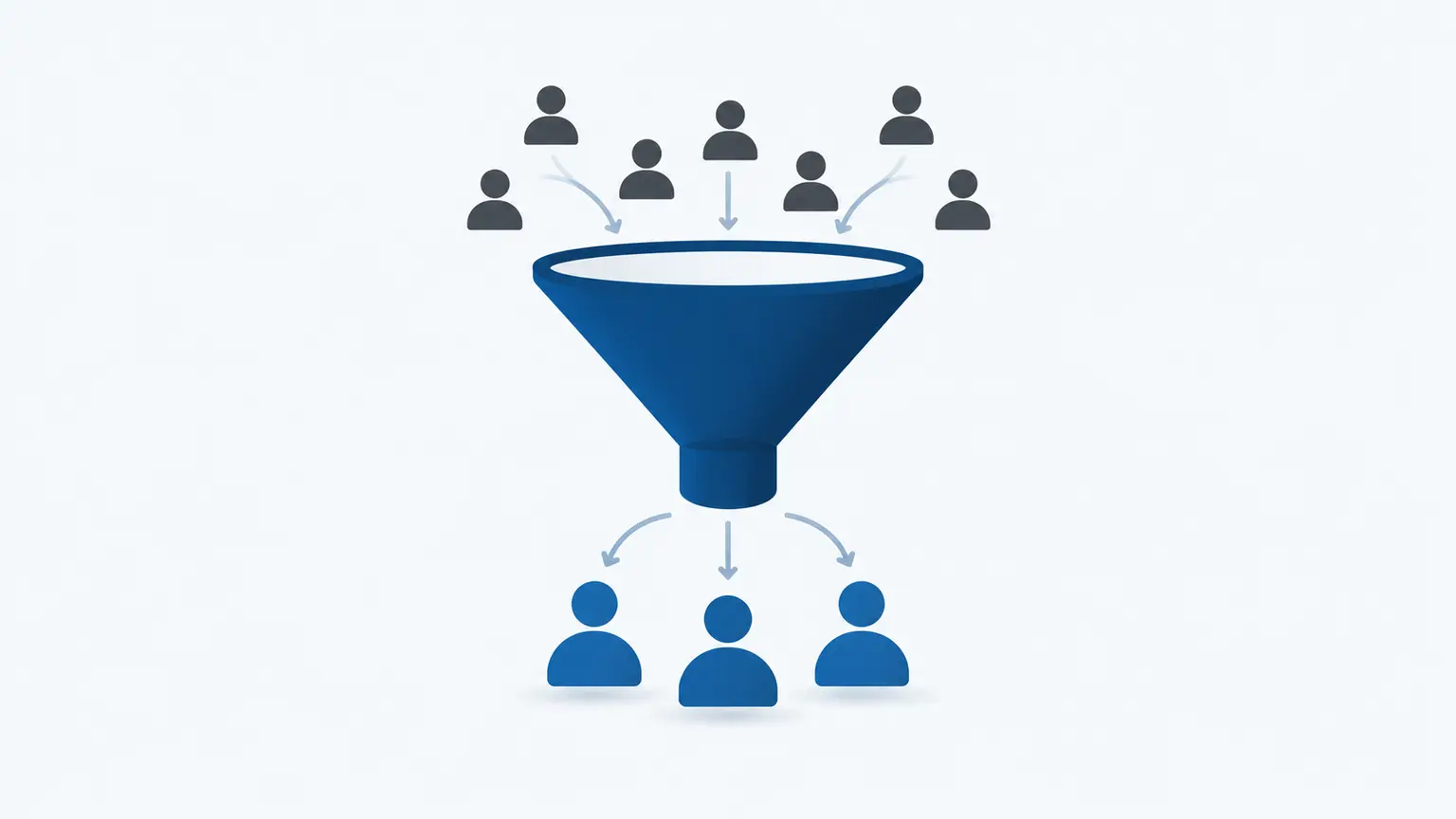
The wide top of the funnel represents the larger group of people who may recognise a problem or encounter your business. The narrowing stages represent increasingly meaningful actions, such as comparing approaches, requesting a quotation and becoming a customer.
A simple funnel uses three stages:
Some businesses add retention and advocacy after the first purchase. B2B firms may instead track engaged accounts, qualified enquiries, sales opportunities and won customers. The labels matter less than agreeing what each stage means and measuring it consistently.
Consider a small cyber-security consultancy selling to professional-services firms. Its awareness activity might include practical articles about client security questionnaires. A comparison guide and case study could help an operations director during consideration. A scoped security review gives a serious prospect a clear next step.
The consultancy might track 200 relevant accounts engaging with its material, 20 qualified enquiries, eight sales opportunities and two new customers. The stage conversion rates would be 10%, 40% and 25%. Those figures describe this example only; they are not benchmarks for another market.
Without a funnel, teams often optimise the easiest number to increase. More website visits can look encouraging while qualified enquiries remain flat. A funnel makes the relationship between activity and commercial progress visible, so you can investigate the stage where suitable buyers stop moving.
It also helps you choose content more deliberately. An introductory article should not carry the whole burden of closing a complex sale, while a detailed implementation guide may be wasted on somebody who has only just recognised the problem.
Do not mistake the model for the customer journey. A buyer may hear about you from a colleague, visit twice, disappear for four months, return through search and then involve finance and IT. Different people within one buying group may also sit at different stages.
Keep the unit of measurement consistent. Dividing account-level opportunities by individual website visitors produces a percentage, but not necessarily a meaningful conversion rate.
They overlap, but teams often use a marketing funnel for awareness and demand creation, then a sales funnel for qualified opportunities moving towards a decision. A shared end-to-end model usually prevents arguments about where one supposedly stops and the other starts.
These abbreviations mean top, middle and bottom of funnel. They are shorthand for early awareness, active consideration and decision-stage activity. Use the plain stage names if the abbreviations make the discussion less clear.
Who wrote this

Steve founded Epitomise in 2017 after UK, international and global marketing leadership roles, most recently as Global CMO of the Vitec Group’s Videocom Division. He works with SME and technology businesses on strategy, positioning and the execution that follows — more about Steve.
Read next
Learn what A/B testing means, how a controlled marketing experiment works and which mistakes make test results unreliable.
Learn what answer engine optimisation means and how to make useful business content easier for search and AI systems to extract and cite.
Learn what bounce rate means, why analytics tools calculate it differently and how to diagnose a high bounce rate without guessing.
A short discovery call is usually enough to tell. No deck, no pitch.
Book a discovery call