ABM for UK SMEs including the use of AI
ABM for UK SMEs: how to run account-based marketing with a small team, and use AI for account research and outreach without losing credibility. Updated for 2026.

Channels
Many factors influence which marketing communication channels will actually reach your target audience. Every channel has its merits. The question is which ones will achieve your aims.
Will your growth come from Google Ads, networking memberships and LinkedIn InMails? From webinars and face-to-face seminars? From advertising on social platforms? There is no general answer, but there is a reliable way to find yours.
The overriding principles of marketing are straightforward once you are clear about what you want to achieve. A structured approach brings the variables into focus.
Start by answering three questions to create the strategic plan:
The marketing plan follows: product, price, place, process, people and promotion. The promotion part is where the channel question lives, and it turns on three things:
When you think about reaching a person inside a target company, the options depend on whether you know who they are. Say you want to reach a managing director:
Scenario 1. You do not know who the managing director is, you do not have their contact details, and you certainly do not have permission to contact them.
Scenario 2. You know exactly who they are, you have their details, and you have the appropriate permissions.
To address both, you need outbound and inbound strategies.
Outbound marketing pushes your message out to an audience. It is a disruptive approach: you are putting messages in front of people and hoping they engage.
Inbound marketing meets your audience as they engage with you. It is often called pull marketing, because you are pulling customers towards the business rather than pushing at them.
The key to choosing well is to start with the target audience and the journey they will take. Depending on what you sell, that journey can be short and simple or long and complex.
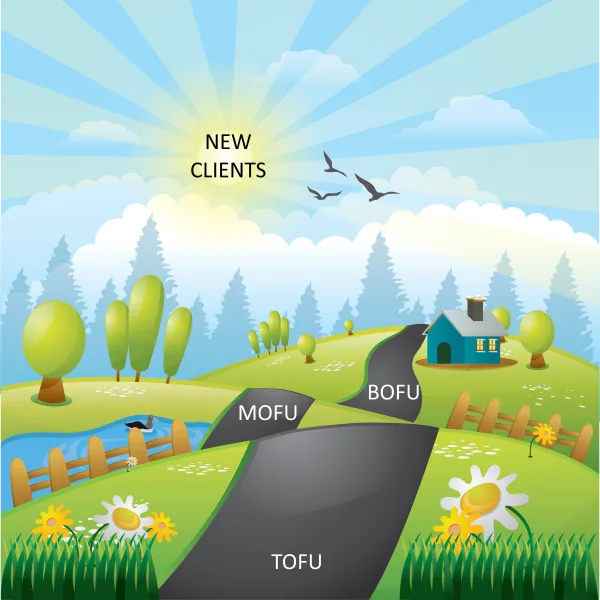
An example journey runs from discovery, where they find you, through exploration of what you offer, evaluation of your business, the purchase decision, and retention, where they decide to stay and grow with you.
Thinking this through for your own products and services will point at the right channels. So will your budget and your resource. One channel alone is rarely enough to generate the engagement you need, so plan for a combination if you can afford one.
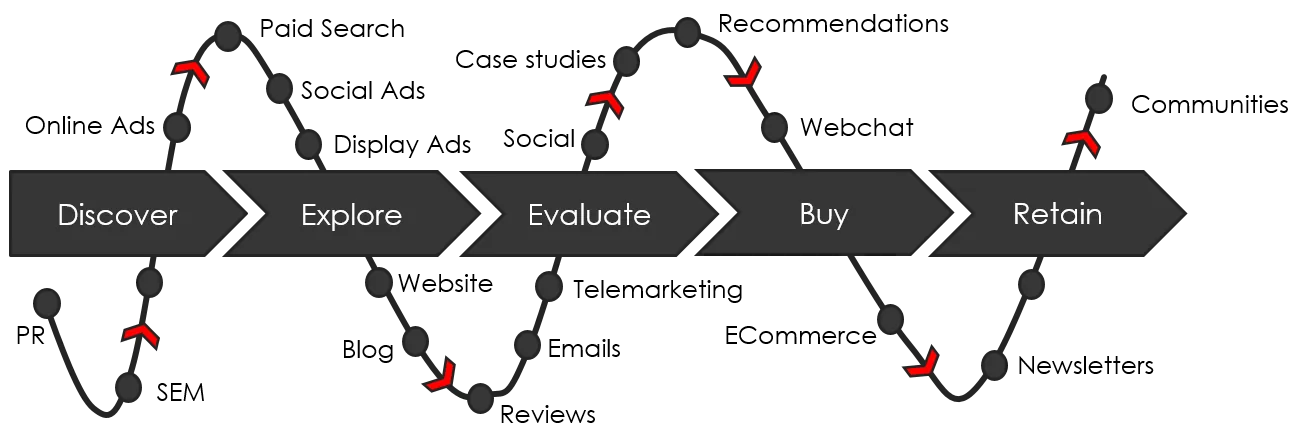
The top of the funnel is where you create initial demand. The middle is where you nurture it into further engagement. The bottom is where engagement is deep and you are converting interested prospects into customers.
Channels and content change as you move down. You might use advertising at the top to create interest — see our post on the benefits of Google Ads. When someone engages but is not ready for a quote, email nurtures in the middle keep the relationship moving. When they are seriously interested, a detailed webinar at the bottom helps them decide. The vehicle changes as the journey progresses.
Thinking in stages tells you what to measure, for each channel and for the mix as a whole.
At the top: impressions, click-through rates, total enquiries. In the middle: marketing qualified leads, where qualification means BANT — budget, authority, need and time. At the bottom: the value and number of proposals issued, video references viewed, demonstrations given.
Together those indicators show engagement and progression through the funnel from your campaigns and chosen channels.
Before you pick top, middle and bottom-of-funnel channels, do some research. Plenty of tools will tell you the likely reach of a digital channel and the volume of leads it might produce. The keyword tool in Google Ads, for example, will tell you roughly how often a term is searched. From that you can project impressions, click-through rates, form fills, marketing leads, sales leads and orders, and decide whether the channel can plausibly deliver what you need.
Apply similar analysis to your other digital and non-digital channels and you will know, before you spend, whether the plan creates and converts enough demand.
With social channels, think about reach to your specific audience. Most platforms allow targeted advertising, so alongside a longer-term effort to grow followers organically you can use targeted ads or boosted content to reach a specific profile now. Targeting can be precise enough to reach named companies, which is how social supports an account-based marketing strategy.

The platforms group roughly into:
Consider who uses each platform, and whether you are there to network, to publish or to share. If your audience skews young, the photo and video sharing platforms are worth more of your attention than the networking ones.
If social is a priority for you, read 4 strategies to maximise business results from social media marketing.
There are several published views on which channels are most effective. Personally, I think it is very hard to judge a channel without knowing the objective and the audience. Each one works for a specific purpose, and which is better depends entirely on what you are trying to do.
As an average B2B perspective, though, Marketing Charts publishes a useful external view of channel effectiveness measured by impact on revenue.
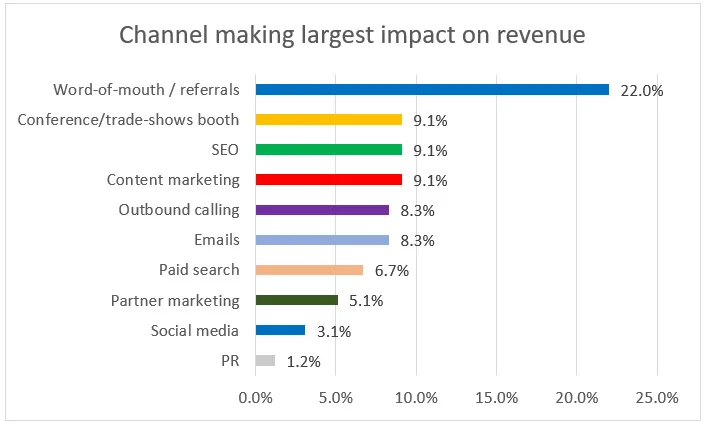
Analysing the expected impact of each channel tells you how much to spend on it. But also consider the average lifetime value of a new client. A trojan-horse acquisition strategy can look like a poor multiplier at first, and yet over a three-year view, once repeat and expansion sales are counted, it may change what you are willing to invest to win a client.
Second, purchases are made by individuals and by teams. More complex sales need a plan for everyone involved in the decision.
Each channel works for a specific purpose, and which is better depends on what you are trying to achieve. Take a structured approach. Start with your aims and your audience, think about their journey, and identify what matters at the beginning, the middle and the end of it. Research the reach of your shortlist. Project the investment and the return from each channel, then measure results against your expectations. Whatever you use, keep tweaking and optimising.
Many small businesses seeking higher growth say, with hindsight, that they wish they had invested in marketing sooner. Doing the right things in the right way is what makes the growth aim achievable.
For more on creating demand, read 5 tips to improve demand generation results and Create cost-effective agile marketing campaigns.
Who wrote this

Steve founded Epitomise in 2017 after UK, international and global marketing leadership roles, most recently as Global CMO of the Vitec Group’s Videocom Division. He works with SME and technology businesses on strategy, positioning and the execution that follows — more about Steve.
Read next
ABM for UK SMEs: how to run account-based marketing with a small team, and use AI for account research and outreach without losing credibility. Updated for 2026.
Where AI genuinely helps with marketing strategy and where it quietly misleads. A practical workflow for UK SMEs, updated for 2026 with what changed when AI started doing its own research.
Run marketing as a repeatable quarterly cycle — Review, Focus, Implement, Optimise — so strategy turns into shipped work and measurable pipeline.
A short discovery call is usually enough to tell. No deck, no pitch.
Book a discovery call