
ABM for UK SMEs including the use of AI
ABM for UK SMEs: how to run account-based marketing with a small team, and use AI for account research and outreach without losing credibility. Updated for 2026.

Effectiveness
Marketing rarely underperforms for exotic reasons. From years of conversations with companies of every size, the same mistakes come up again and again — no plan, no measurement, no follow-through — and each of the twenty-five below has a quick fix that is a matter of discipline rather than budget.
Use Google Analytics and set your goal triggers, such as a form-fill thank-you page, so you know which components of your marketing are working and creating conversions.
Less is more. Whatever you do, know what you expect from it and do it well. If you create an article to support social outreach, email and organic search, work that article until it achieves what you created it for. It is far too easy to publish, assume the job is done, and move on to the next piece.
Would you build a house without a plan? Then do not try to build a business without one. If you want to create it yourself, our guide to creating business marketing strategies will help.
No one wants to spend money badly, but cheap is rarely best. The key is total control of spend and of what you expect back, and by when. Understand your month-by-month targets and spend, and measure progress against them. On track or ahead? Consider doubling down. Behind? Adjust, change or stop. Cheap with no return is the most expensive option there is.
Marketing is not about sending a social post or building a pretty website. It is about delivering results. Before you spend anything, know the targets you expect, then measure progress and optimise relentlessly.
We all want our marketing to look good and our brand to reflect the company’s values. But a beautiful website that was not built as a workhorse for your marketing, and attractive collateral that nobody sees, is wasted money. Think carefully about priorities first, then research what marketing is actually required to support them. When budgets are limited you will have to prioritise, and aim for reasonably good rather than perfect.
Please do not do it. Your website supports your marketing; your marketing does not support your website. Many of our landing pages are not linked from the main navigation at all — each one is written for a specific target market and a specific commercial aim, and reached through a campaign rather than through browsing. Not every page has the same job, and knowing that is critical to hitting your commercial aims.
A common example: expecting a prospect who does not know you to sit through a four-minute client case study video about how good your business is. A case study video is a bottom-of-funnel asset. Hero content — content so desirable that people who do not know you will engage to get it — belongs at the top. What hero content do you have?
Modern marketing technology is genuinely impressive. Resourcing it fully enough to take advantage of its powerful features is another story. Marketing is a process: aligning with people searching for you, or reaching out to your target prospects. Understand the process you want, then use tools to support it — rather than spending all your limited resource supporting the tool.
Winning sizeable opportunities takes a mature, considered approach. The higher the order value, the more complex the sales and marketing process. Trust is critical: the more a purchase costs, the harder a buyer works to avoid a career-limiting decision. In larger companies, teams decide, so your marketing has to reach influencers as well as decision-makers. All of that takes time, and your expectations need to align with a longer play — not asking where the leads are a week after the campaign went live.
It is much easier to decide things ourselves, on what feels like sound experience, than to go and ask our customers. The problem is that what we think is often significantly different from what our customers and prospects think. Rose-tinted glasses hinder your approach, your effectiveness and your results.
Many companies need short-term results to hold stakeholder confidence, then describe strategies that cannot possibly deliver them quickly. “We need SEO and quality content so we are visible on Google and people find us” is a contradiction if the timeframe is weeks: SEO rarely delivers quickly. To be found on search engines fast, a paid approach is more likely to be required.
Used well, automation lets you market your business when you have no spare resource and at your busiest times. In quieter periods, create your content and use tools to leverage it in the months ahead: trigger email nurtures, forward-scheduled social posts, automated personalised content. Used inappropriately, though, automation consumes all of your resource chasing features — lead scoring, personalisation, predictive analytics — that may have limited real-world value to your business.
It is all too common to create content, post or email it, and move straight on. When you create content, be clear why you are creating it and what you expect from it. Then keep working it until it earns its keep.
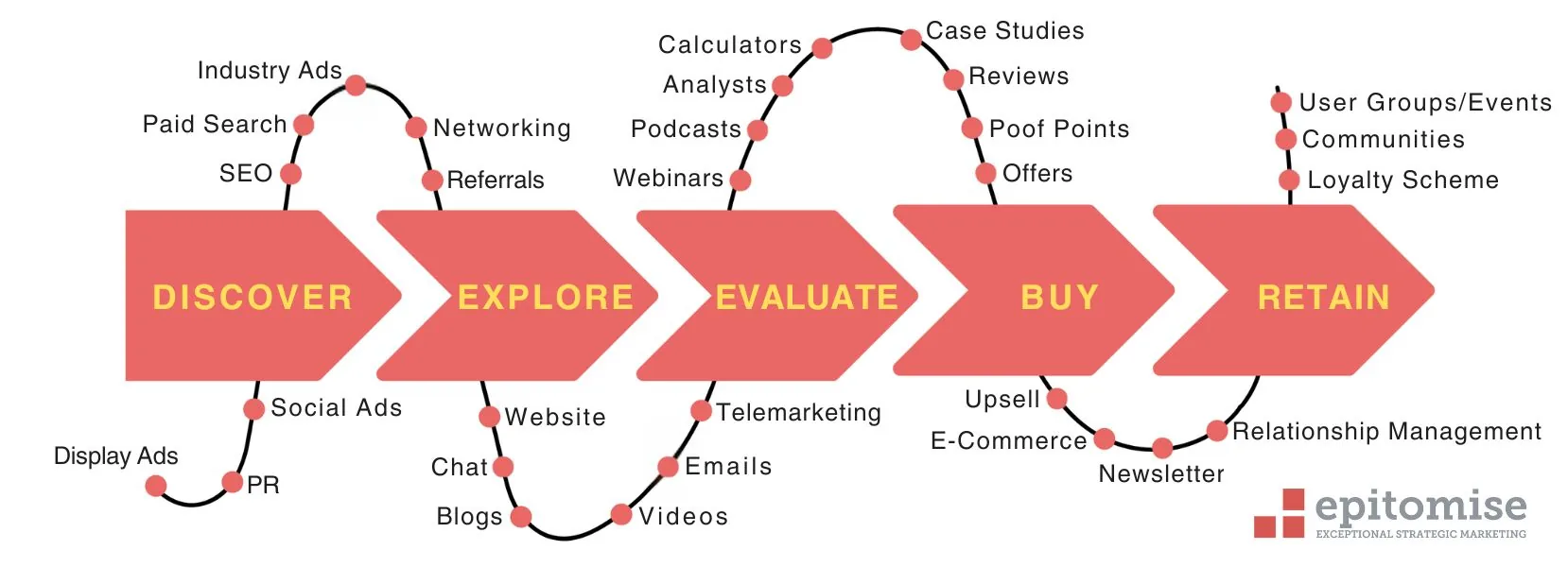
To get the best overall impact, make sure you have a joined-up process running from first contact to loyalty. The journey starts with people searching and finding you, or with you reaching out to target prospects, then nurtures and progresses the relationship through to a first order and on to repeat purchase.
Start by reflecting on your company’s strengths relative to your target market and your business opportunities. The tools in our guide to creating business marketing strategies will help with that exercise. Once you know your strengths, make sure your client-facing, value-based messaging carries the relevant ones through.
In a digital world it is remarkable how transparent your competitors’ marketing is — and how many companies are too busy to look. Learning from others improves the return on your own spend quickly. Look at a competitor’s social feed now: it will tell you which events they attend, what content they create and what successes they are having. Tools such as SEMrush or SpyFu will show you where they perform organically and in paid search.
You have had the spam email: “Your website is not ranked #1 in the search engines? If you want more visitors it is important that you have a top search engine position. Our prices are less than half of what other companies charge.”
These spray-and-pray messages damage marketing’s credibility and destroy trust in marketing companies. Between the confusing claims, the false statements and the over-promises, it is genuinely hard to know what is right for you.
Being found by people searching for your services matters, and a considered SEO strategy can deliver medium- to long-term results. Know what you are trying to achieve and how you plan to achieve it, then select the methods and partners to help you. A researched approach with clear targets keeps you on track, rather than making ad hoc decisions that inevitably disappoint.
One of the biggest problems business owners have is managing their own marketing while delivering exceptional service to clients. Marketing goes on the back burner and starts to feel like a mountain. Remember that Rome was not built in a day, and neither are good websites. Have a plan, focus on one piece of work at a time, and finish it to the highest quality you can manage at that point. Waiting for perfection everywhere stalls everything.
If you post carefully considered content to people who are not your target purchasers, you will be disappointed with the results. How many of your social connections are actually future buyers? Relevant hashtags extend reach, and a liked or shared post might reach a target — but it is common for significant effort to go into creating and posting with no real reach behind it. Choose vehicles that reach your target audience. Our article on channels of communication covers how.
If you try to be everything to everyone, you will likely be nothing of substance to anyone. Substance has depth, and depth takes focus and time. Target everything and your messaging thins out and your spend spreads too thinly to make a difference. Focus builds understanding, and understanding builds value. That focus can be a vertical market, a horizontal one, or a set of defined segments.
“That didn’t work for us previously, so we aren’t interested in doing it again” is a very common statement. Everything in the marketing mix works in the right circumstances. The difficulty is that very different situations can apply to businesses that look similar on the surface — search advertising worked for one and not the other. Do not dismiss anything outright. Implement your chosen strategies carefully, then monitor and optimise to make sure the planned results are being achieved, or are clearly on their way.
Consider why you are doing something before you do it. Why are you writing this article? For your website, your email programme, your social sharing? Used with automation, as described in mistake 13, that content has immediate and longer-term value. With a little thought — aligning it with carefully selected search terms and structuring it well — it may perform organically over time too, rather than being one and done. Our article on SEO strategy covers how.
The tip for mistake 10 applies here too: winning sizeable opportunities takes a mature, considered approach.
Stakeholders are usually worried that their marketing investment may not work. That creates pressure for early results, which is not always possible — and that is exactly why early success indicators need to be defined and shared with everyone. Progress against them gives confidence that the investment is on plan, even before a win lands. Embrace early campaign learning and keep optimising towards the indicators you agreed.
Last but certainly not least. Align with what your target prospects are looking for and that you can help them with. To know that, research what they search for and what their top questions are, then create content that answers them. Our article on strategically targeting and segmenting markets goes further, including the example of a training company deciding whether to position around “leadership development programme” or “leadership training”.
There you go: twenty-five mistakes that together can destroy the value of any company’s marketing, and the tips to avoid them. From your experience, are these the common mistakes you see, or are there others missing?
If you found this useful, our article on where marketing budget gets wasted and how to fix it is a good next read.
Who wrote this

Steve founded Epitomise in 2017 after UK, international and global marketing leadership roles, most recently as Global CMO of the Vitec Group’s Videocom Division. He works with SME and technology businesses on strategy, positioning and the execution that follows — more about Steve.
Read next
ABM for UK SMEs: how to run account-based marketing with a small team, and use AI for account research and outreach without losing credibility. Updated for 2026.
Where AI genuinely helps with marketing strategy and where it quietly misleads. A practical workflow for UK SMEs, updated for 2026 with what changed when AI started doing its own research.
Run marketing as a repeatable quarterly cycle — Review, Focus, Implement, Optimise — so strategy turns into shipped work and measurable pipeline.
A short discovery call is usually enough to tell. No deck, no pitch.
Book a discovery call