Account-based marketing: focus effort on valuable accounts
A practical account-based marketing guide for selecting target accounts, coordinating sales and marketing, and measuring meaningful progress.

Marketing guides
Conversational marketing helps buyers get useful answers through live chat, messaging, guided website experiences and human sales conversations. Its value is not the chat bubble. It is the ability to remove uncertainty while someone is actively considering a problem. A fast, relevant answer can keep a buyer moving; an instant but useless automated reply merely creates friction at machine speed.
Part 3 of Execute Your Tech Idea looks across the channels a business can use to reach and convert a market. Conversation deserves a place because buyers do not always follow a neat form-and-email journey. They ask questions, test assumptions and decide whether the business understands them before they volunteer a phone number.
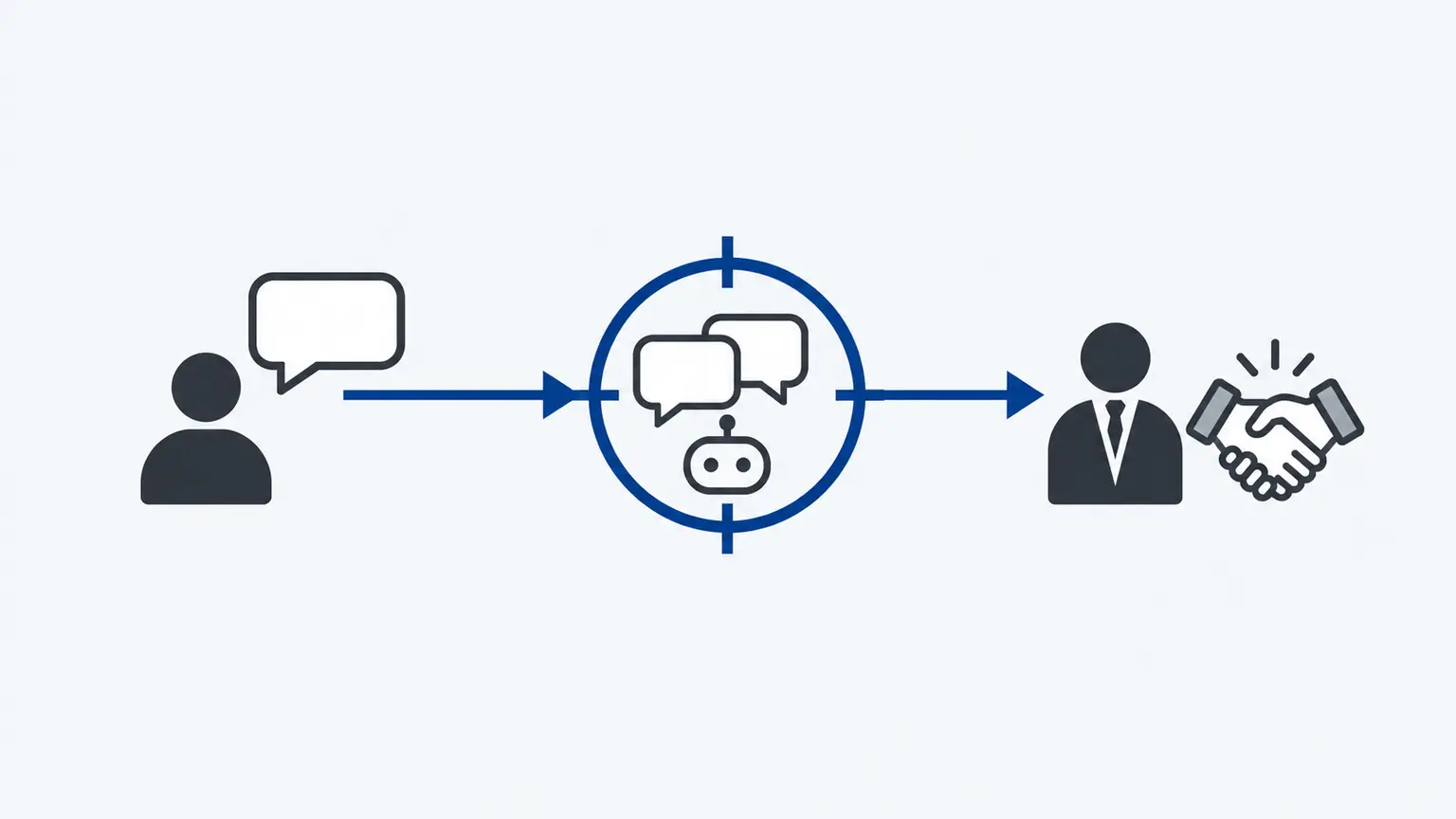
Conversation works well when buyers have recurring questions that block action: suitability, integration, availability, pricing drivers, implementation or risk. It can support complex services, considered purchases and products where the right choice depends on context. It also helps when prospects arrive outside normal sales processes, perhaps from an article, event or recommendation.
It adds less value when website content should answer the question clearly on its own, when nobody can maintain the service or when the conversation exists only to collect contact details. Before installing anything, review enquiries, sales calls and site searches. Identify where people hesitate and which answers genuinely help them proceed.
Live chat gives a visitor access to a person in real time. It creates trust when the responder has enough knowledge and authority, but it also creates an expectation of availability. State operating hours and likely response times honestly.
Asynchronous messaging lets someone ask now and receive an answer later without staying on the page. It may suit small teams better, provided the handover preserves context and the buyer knows when to expect a response.
Automated assistants can answer defined questions, collect useful context, route enquiries and offer relevant resources. They should not invent advice, hide their nature or trap someone in a loop. Give the user a visible path to a person, especially where the question involves risk, money or an unusual requirement.
Guided forms and questionnaires also count as conversational when each question helps the buyer reach a more suitable next step. They can be more reliable than free-text automation for qualification or recommendations with clear rules.
Collect questions from sales calls, support requests, proposals and website enquiries. Group them by stage: understanding the problem, comparing approaches, judging fit, estimating cost and preparing to act. Write short, accurate answers and link to deeper guides or articles and insights where more context helps.
Define what the system may answer, what it should clarify and what must move to a human. Give automated responses approved source material and a safe way to say that the answer is uncertain. If you use generative AI, test common questions, ambiguous phrasing, hostile inputs and requests outside scope. Review conversations regularly because a plausible wrong answer can sound more confident than an honest colleague.
Conversation design should feel like a helpful exchange. Ask one necessary question at a time, explain why personal information is needed and do not request an email before offering any value. Preserve the conversation when handing over so the buyer does not repeat everything.
Agree who owns each type of conversation and what makes an enquiry qualified. Route existing customers, job applicants, suppliers and sales prospects correctly. A simple triage rule can protect the sales team from noise while giving everyone a useful destination.
Set service levels by channel and priority. An active buying question may deserve a rapid response; a general resource request may not. Brief responders on the value proposition, boundaries and next steps. Give them useful links, booking access and CRM visibility rather than expecting them to improvise.
Record consent and purpose carefully. A person asking a question has not necessarily agreed to marketing messages. Keep transcripts only as long as needed, protect sensitive information and explain how data will be used through the appropriate privacy notice.
Useful measures include:
Do not reward a bot for starting more conversations if those exchanges frustrate visitors or create unqualified work. Compare journeys with and without conversational support where traffic permits. Review which questions should improve the website itself; the cheapest conversation is often the one good content makes unnecessary.
Conversation can improve digital demand generation, paid campaigns, product pages and event follow-up. It reveals language that can strengthen value messaging and identifies questions for a useful marketing glossary. Email can continue an agreed conversation, while CRM and sales processes ensure the context survives beyond the first reply.
No. Live chat is one format. Conversational marketing can include messaging, automated assistants, guided forms and sales conversations, provided they help a buyer exchange information and reach a useful next step.
No. A chatbot should solve a recurring buyer problem that clear page content or a simple form cannot solve better. If the business lacks reliable answers, maintenance or a human escalation path, the chatbot is likely to add friction rather than remove it.
Set a response time that matches buyer urgency and team capacity, then state it clearly. An honest two-hour expectation is better than pretending to offer instant help and leaving the visitor waiting. Track actual performance and adjust staffing or promises accordingly.
If you want to turn recurring buyer questions into a sensible journey, contact Epitomise to map the conversation, content and handover before choosing the platform.
Who wrote this

Steve founded Epitomise in 2017 after UK, international and global marketing leadership roles, most recently as Global CMO of the Vitec Group’s Videocom Division. He works with SME and technology businesses on strategy, positioning and the execution that follows — more about Steve.
Read next
A practical account-based marketing guide for selecting target accounts, coordinating sales and marketing, and measuring meaningful progress.
How to plan outdoor advertising with a clear audience, location, message and measurement approach, from local posters to digital out-of-home.
Plan targeted direct mail that earns attention, supports digital campaigns and produces measurable business conversations.
A short discovery call is usually enough to tell. No deck, no pitch.
Book a discovery call