Billboards, posters and out-of-home advertising: a practical guide
How to plan outdoor advertising with a clear audience, location, message and measurement approach, from local posters to digital out-of-home.

Marketing guides
Account-based marketing concentrates sales and marketing effort on organisations that would make valuable, credible customers. It replaces indiscriminate volume with deliberate account selection, relevant insight and coordinated contact across the buying group.
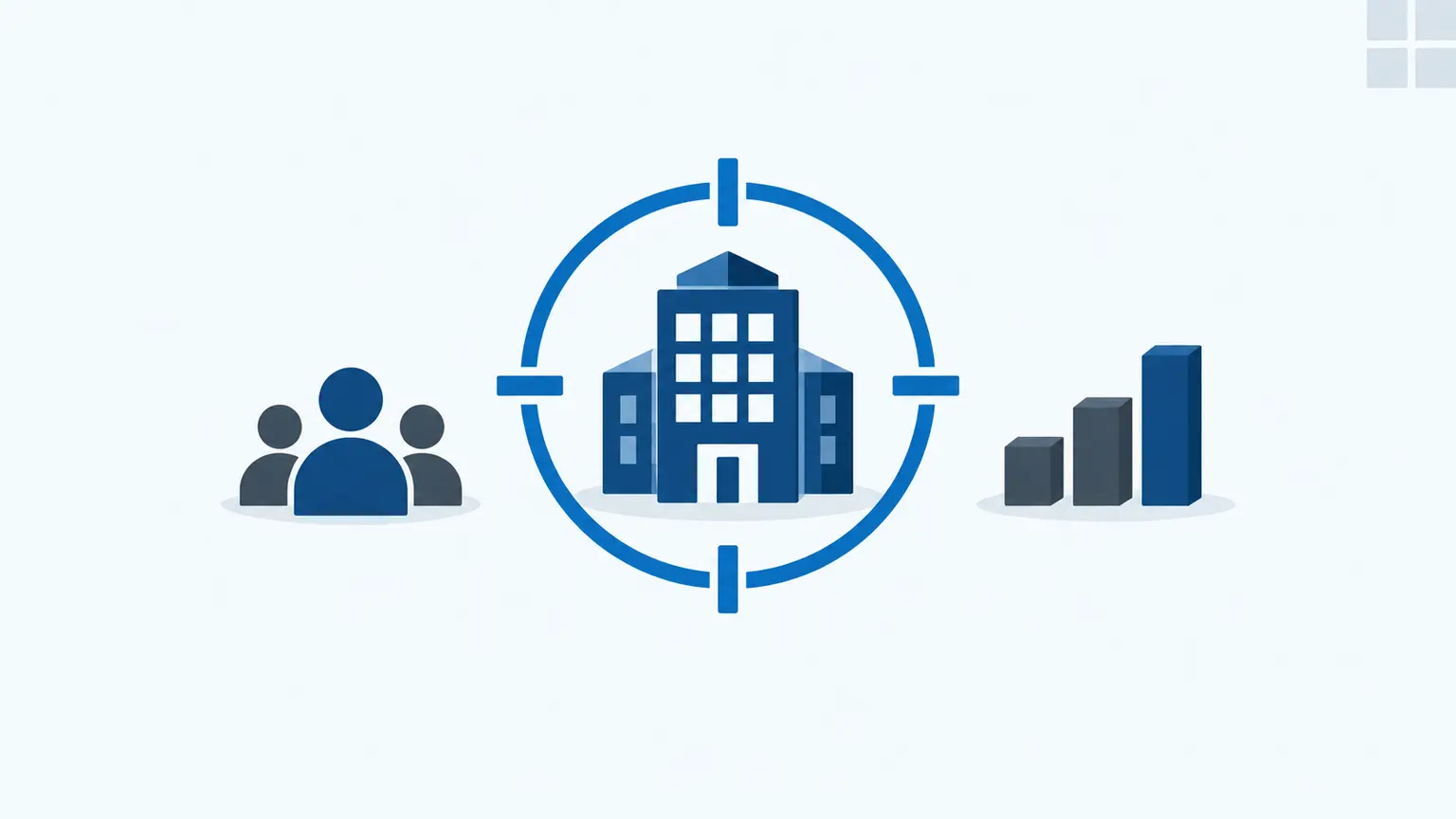
Account-based marketing, usually shortened to ABM, treats a target organisation as the market. Instead of generating a large pool of individual leads and qualifying them later, you identify suitable accounts first and design activity to earn attention from the people involved in a decision.
ABM ranges from one-to-one programmes for a handful of strategically important organisations to one-to-few campaigns for groups with similar needs. A broader one-to-many approach can use shared sector propositions, but it should still be driven by account fit rather than a purchased list and a mail merge.
The ideal customer profile determines which organisations belong on the list. Within them, map likely users, sponsors, technical evaluators, budget holders and blockers. This buying-group view is important because complex business purchases rarely depend on one person.
ABM can support the whole journey. Early activity creates recognition and demonstrates understanding. Mid-journey content helps stakeholders frame the problem and compare approaches. Later activity can answer account-specific concerns, build consensus and reduce perceived risk.
It is strongest when the potential account value justifies research and personalisation. Part 3 of Execute Your Tech Idea explains multiple routes to market; ABM acts as an orchestration method across several of them. Direct mail might earn initial attention, telemarketing can open a relevant conversation, events create face-to-face access and email supports follow-up.
ABM should complement genuine inbound demand, not create an excuse to ignore it. If someone from a target account visits, enquires or engages, connect that signal to the account plan and respond appropriately.
ABM works when customer value is relatively high, the addressable market is identifiable and several stakeholders shape the decision. It also helps when your proposition changes meaningfully by sector, operational context or account maturity.
It wastes money when the target list reflects aspiration rather than fit, research never changes the message, or sales and marketing run separate activities against the same organisation. It also struggles when the offer is low-value and self-serve; the cost of account research can exceed the likely return.
Personalisation must be useful. Mentioning a prospect’s university or recent holiday may prove that you can browse the internet, but it does not prove you understand the business problem. Use public evidence, observed behaviour and legitimate first-party information to form a relevant point of view—then remain open to being wrong.
Start with perhaps ten to twenty accounts rather than hundreds. Define selection criteria such as sector, size, geography, technology, triggering change and potential value. Record why each account qualifies so the list can be challenged.
For each account or cluster:
Coordinate ownership in the CRM. Everyone should see the account hypothesis, known relationships, recent activity and next action. That prevents duplicate approaches and makes transparency possible when a colleague or partner already knows the organisation.
Measure account coverage, meaningful engagement across the buying group, meetings, qualified opportunities, stage progression, pipeline created or influenced, win rate and deal velocity. Compare results with a suitable non-ABM group where possible, while recognising that small account sets make false precision tempting.
Do not optimise for opens, impressions or the number of personalised assets produced. They can diagnose delivery, but they are not the outcome. Define what counts as engagement before launch; a substantive reply or meeting is more meaningful than an automated email open.
Track customer acquisition cost using research, data, creative, media and sales time. ABM can support a higher acquisition cost when expected lifetime value and strategic fit justify it.
Use the smallest number that produces useful learning without overwhelming the team. A small account set can be enough for a focused pilot; choose the number from account complexity and available research capacity rather than a universal range.
No. It suits any identifiable market where account value justifies deliberate research and coordinated attention. The depth of personalisation should remain proportionate to potential value.
Who wrote this

Steve founded Epitomise in 2017 after UK, international and global marketing leadership roles, most recently as Global CMO of the Vitec Group’s Videocom Division. He works with SME and technology businesses on strategy, positioning and the execution that follows — more about Steve.
Read next
How to plan outdoor advertising with a clear audience, location, message and measurement approach, from local posters to digital out-of-home.
How to use live chat, messaging and helpful sales conversations to reduce buyer friction while protecting trust and team capacity.
Plan targeted direct mail that earns attention, supports digital campaigns and produces measurable business conversations.
A short discovery call is usually enough to tell. No deck, no pitch.
Book a discovery call