Account-based marketing: focus effort on valuable accounts
A practical account-based marketing guide for selecting target accounts, coordinating sales and marketing, and measuring meaningful progress.

Marketing guides
Events can create concentrated access to a market, but presence alone does not produce a return. The commercial work starts before the doors open: choose the right audience, give people a reason to engage and design the follow-up while the conversation is still fresh.
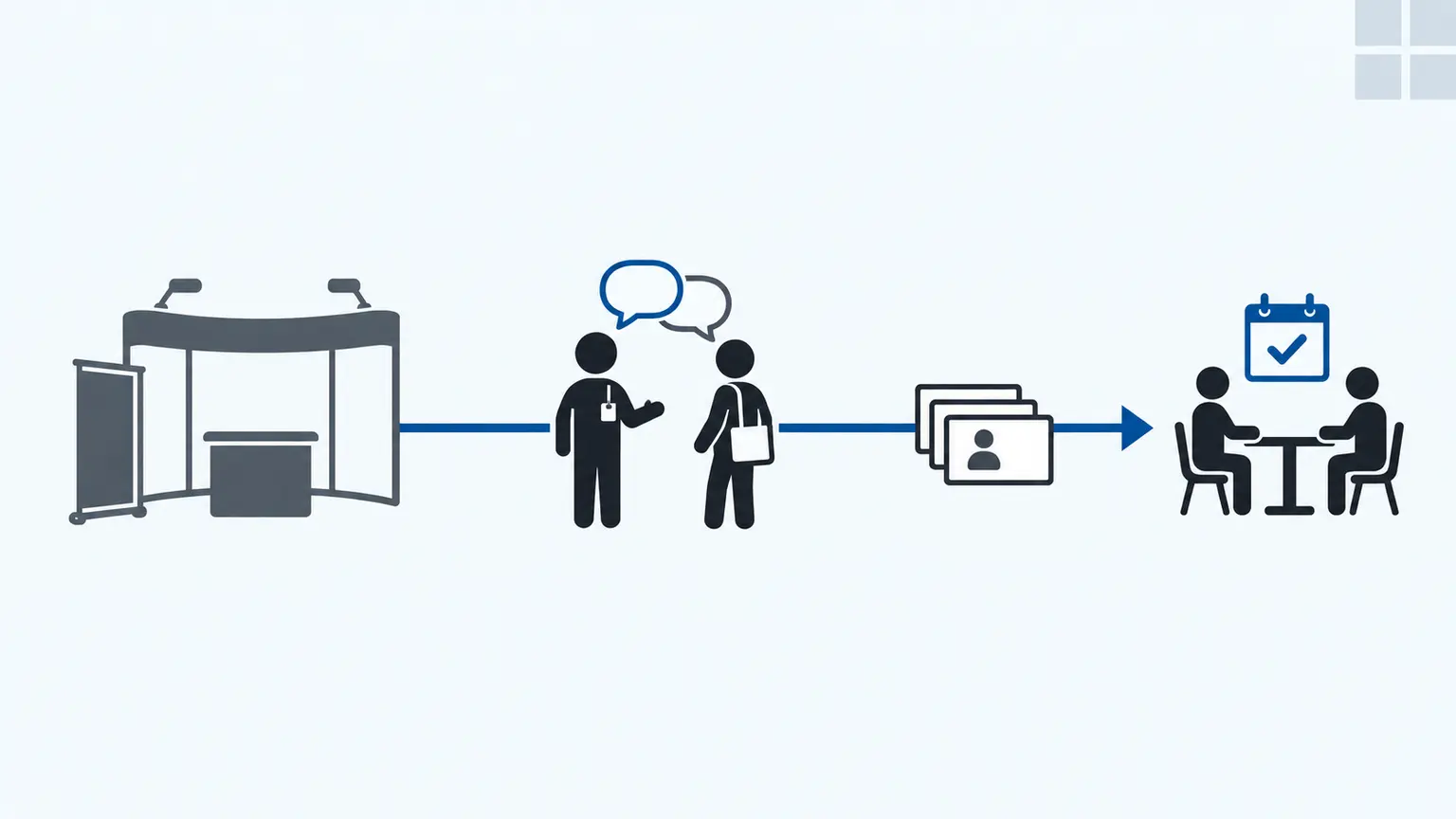
Event marketing uses in-person or hybrid experiences to create awareness, conversations, learning or commercial opportunities. It includes hosting your own event, speaking, attending, sponsoring, and exhibiting at a trade show or consumer show.
Each format gives you a different role. Hosting provides control over audience and experience but makes you responsible for attendance. Exhibiting offers concentrated footfall but places you beside competitors. Speaking transfers some authority from the organiser to you. Attending without a stand can be effective when pre-arranged meetings matter more than broad visibility.
The right question is not “Which show should we book?” It is “Whom do we need to meet, what useful interaction can we create and what should happen next?” That keeps expenditure connected to a customer journey map rather than to tradition or fear of missing out.
Large shows usually create awareness and early-stage discovery. Specialist roundtables, workshops and demonstrations can influence consideration because attendees can explore a problem in detail. Pre-arranged meetings and customer events may support evaluation, retention or expansion.
Part 3 of Execute Your Tech Idea sets events alongside other routes to market because their value increases when channels work together. Account-based marketing can identify priority attendees before a B2B exhibition. Email marketing can invite, remind and follow up. Press relations may amplify original announcements or research, provided there is a real story.
Map the intended next step for each audience segment. Someone who watched a ten-minute demonstration needs different follow-up from someone who scanned a badge to enter a prize draw.
Events work when the organiser can evidence a relevant audience, the offer benefits from conversation or demonstration, and your team can prepare and follow up properly. They are particularly useful when buyers, partners and influencers gather in one place but are otherwise difficult to reach efficiently.
They waste money when a business buys a stand before defining an objective, measures success in collected badges, or sends staff who wait behind a table checking their phones. Expensive stand furniture cannot rescue a weak proposition.
Be sceptical of headline visitor numbers. Ask for job functions, sectors, seniority, geography, historic attendance and exhibitor feedback. Consider whether the people you want attend for one day, whether competitors dominate the floor and whether meetings can be booked in advance.
Set one primary objective: generate qualified conversations, demonstrate a product, recruit partners, build customer relationships or learn about the market. You can gain secondary benefits, but competing objectives make the experience vague.
Then:
Brief the team on opening questions and qualification, but do not turn them into robots reciting a script. A good event conversation feels human and ends with an agreed action, even when that action is simply “not a fit”.
Track costs fully: space, sponsorship, design, travel, accommodation, staff time, logistics and follow-up. Then measure relevant invitations accepted, meetings booked, qualified conversations, demonstrations, follow-up acceptance, pipeline influenced and eventual revenue.
Calculate acquisition cost only using a meaningful lead definition, and use marketing attribution to record the event’s contribution. Dividing spend by every badge scanned creates a comforting but useless number. Record lead quality, stage progression and time to opportunity so you can compare events fairly.
Awareness objectives require different evidence, such as target-account engagement, relevant traffic, branded search, press coverage or audience feedback. Choose these measures before the event and establish a baseline where possible.
The best follow-up reflects the actual conversation. A generic “Great to meet you” email sent to everyone is administration, not nurturing.
Complete promised actions as quickly as possible, normally within one or two working days. Prioritise contacts by fit and intent, and refer to the conversation so the message is recognisable. Automated speed does not compensate for irrelevant follow-up.
Not automatically. A stand helps when demonstration, visibility and walk-up conversations matter. Attending can produce a better return when you have a small target-account list and can arrange focused meetings without stand and logistics costs.
Who wrote this

Steve founded Epitomise in 2017 after UK, international and global marketing leadership roles, most recently as Global CMO of the Vitec Group’s Videocom Division. He works with SME and technology businesses on strategy, positioning and the execution that follows — more about Steve.
Read next
A practical account-based marketing guide for selecting target accounts, coordinating sales and marketing, and measuring meaningful progress.
How to plan outdoor advertising with a clear audience, location, message and measurement approach, from local posters to digital out-of-home.
How to use live chat, messaging and helpful sales conversations to reduce buyer friction while protecting trust and team capacity.
A short discovery call is usually enough to tell. No deck, no pitch.
Book a discovery call