Account-based marketing: focus effort on valuable accounts
A practical account-based marketing guide for selecting target accounts, coordinating sales and marketing, and measuring meaningful progress.

Marketing guides
Webinars and podcasts let you demonstrate expertise before asking someone to buy. The format matters less than the promise: give a specific audience a useful answer, make the experience worth their time and create a sensible next step.
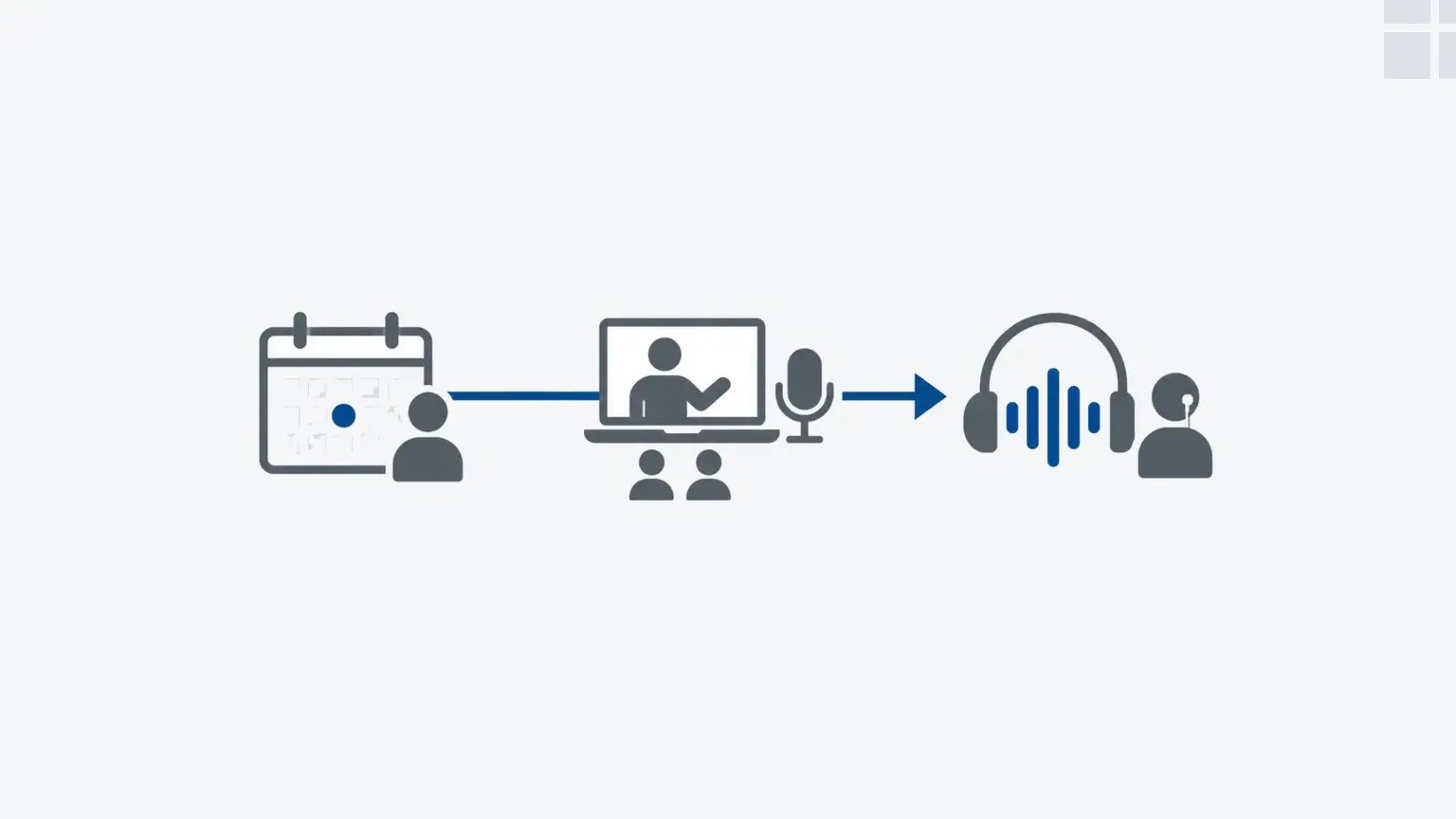
Webinar marketing uses a live or recorded online session to educate an audience, demonstrate an approach and invite further engagement. Podcast marketing can mean producing your own programme, appearing as a guest or sponsoring a programme whose listeners match your market.
Both are authority-building channels. They work because people hear how you think, not merely what you claim. That is particularly useful for complex, high-consideration services where trust develops over several interactions.
The mechanics differ. A webinar normally has registration, attendance and follow-up stages, with a visible call to action. A podcast usually develops attention over a longer period and may influence demand that appears later through search, referral or direct traffic. Measuring both with the same last-click yardstick will produce misleading conclusions.
Webinars work well from early consideration through to evaluation. A broad educational topic can introduce the problem; a practical clinic or demonstration can help an informed buyer compare approaches. Existing customers can also use a webinar to learn about a new service.
Podcasts usually operate earlier. They create familiarity and mental availability, especially when a potential buyer hears the same expert make useful points over several episodes. Guest appearances can borrow the host’s established credibility and reach a relevant audience without the work of building a show from scratch.
Part 3 of Execute Your Tech Idea treats marketing channels as parts of a system. That principle matters here: use email marketing to invite and follow up, social media to distribute useful extracts, and an appropriate landing page to explain the value clearly.
It works when you have a defined audience, a problem you understand and someone who can explain it clearly. Strong topics are narrow enough to feel urgent: “How manufacturers can reduce quote turnaround time” is more useful than “Digital transformation trends”.
It wastes effort when the topic is a disguised sales presentation, the guest list has little connection to the offer, or nobody owns promotion and follow-up. A polished hour-long recording with no distribution plan is an expensive file, not a campaign.
Do not assume you need a weekly podcast. A limited series, guest campaign or quarterly webinar may suit your buying cycle better. Consistency matters, but an unsustainable schedule simply creates rushed episodes and a guilty-looking content calendar.
Start by writing one sentence: “This is for [audience] who need to [make progress] without [common obstacle].” Use it to test the topic, title and invitation.
For a webinar:
For a podcast, decide whether producing, guesting or sponsoring best serves the objective. Define the listener, develop three to six strong themes, and record a small pilot before committing to a season. Build every episode around the listener’s problem; the brand earns attention by being useful.
For webinars, monitor registration-page conversion, qualified registrations, attendance rate, engagement, questions, follow-up responses and opportunities influenced. Raw registrations can flatter a weak campaign if the wrong people attend.
For podcasts, examine relevant audience reach, episode completion where available, visits to memorable URLs, newsletter growth, branded search, invitations and sales conversations that mention the programme. Use consistent “How did you hear about us?” capture because attribution will otherwise miss much of the effect.
Measure business outcomes over an appropriate period. A high-value purchase rarely follows five minutes after a podcast episode. Track the conversion rate of clear next steps, but also record assisted influence in the CRM.
Repurpose selectively. A useful answer might become an article, short video or sales-enablement note. Do not publish twenty near-identical clips merely because software makes them easy to produce.
Use live delivery when questions and interaction improve the subject. Record it for people who cannot attend, but make the live event valuable in its own right. An evergreen recording can work later if the information will remain accurate and the follow-up process still operates.
Usually not. Guest appearances on well-matched programmes are a lower-risk way to test topics and audience response. Produce your own show when you have a distinctive editorial premise, access to worthwhile guests or expertise, and the capacity to distribute it consistently.
Who wrote this

Steve founded Epitomise in 2017 after UK, international and global marketing leadership roles, most recently as Global CMO of the Vitec Group’s Videocom Division. He works with SME and technology businesses on strategy, positioning and the execution that follows — more about Steve.
Read next
A practical account-based marketing guide for selecting target accounts, coordinating sales and marketing, and measuring meaningful progress.
How to plan outdoor advertising with a clear audience, location, message and measurement approach, from local posters to digital out-of-home.
How to use live chat, messaging and helpful sales conversations to reduce buyer friction while protecting trust and team capacity.
A short discovery call is usually enough to tell. No deck, no pitch.
Book a discovery call