Account-based marketing: focus effort on valuable accounts
A practical account-based marketing guide for selecting target accounts, coordinating sales and marketing, and measuring meaningful progress.

Marketing guides
Social media gives businesses a place to publish ideas, engage with customers and reach people beyond their existing network through advertising. It produces value when the audience, content and commercial aim align; activity alone is not a strategy.
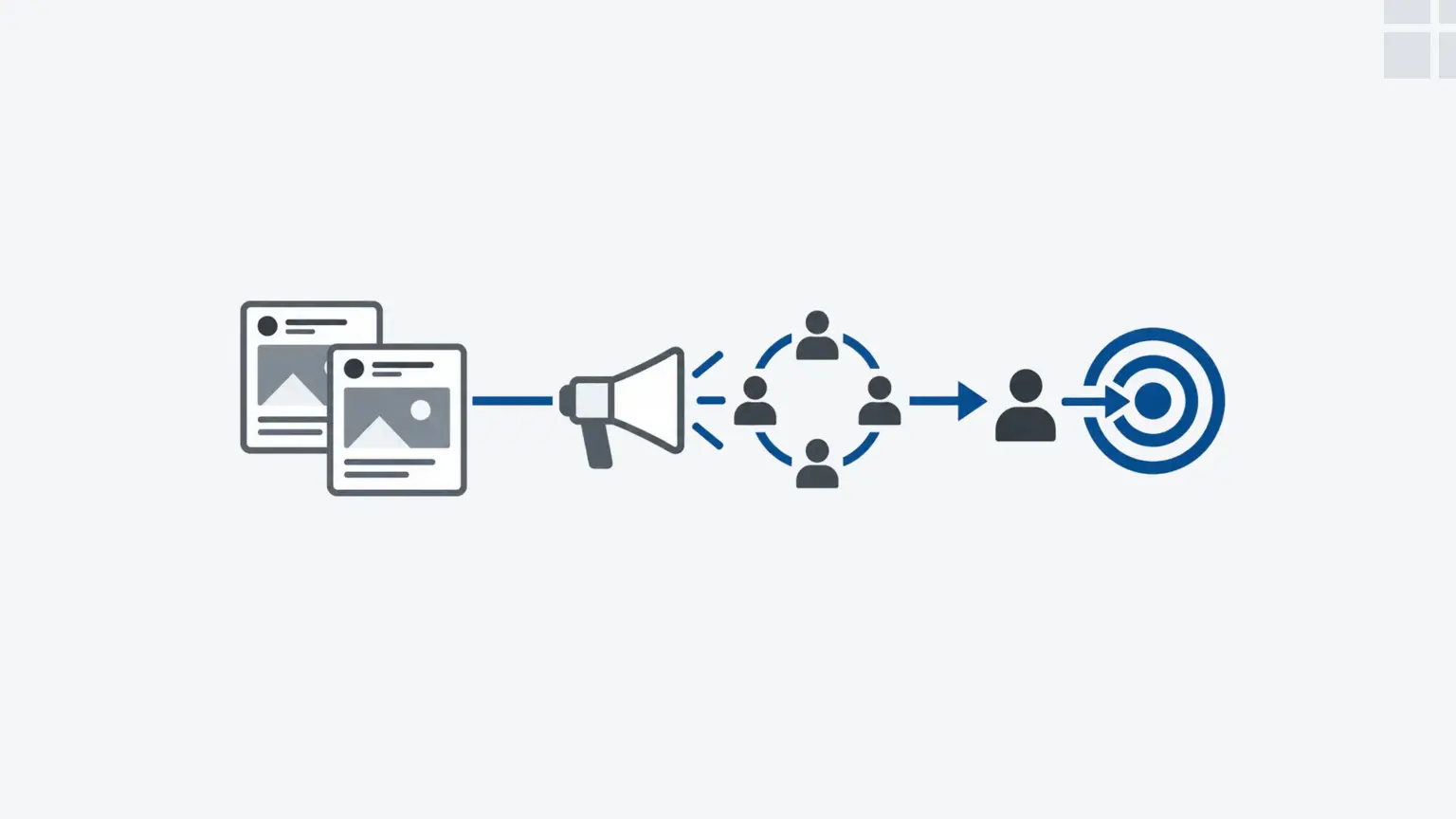
Organic social media marketing includes publishing, commenting, sharing and participating in relevant groups or communities. Paid social advertising purchases distribution through formats such as images, carousels, video, text or platform-specific messages.
Organic activity builds familiarity with your people, perspective, products and brand. Advertising can extend reach beyond followers and target audiences using the platform’s available data. The two can reinforce one another: organic response reveals which themes resonate, while paid distribution exposes strong material to more of the right people.
This guide builds on Steve Ward’s social media channel in Part 3 of Execute Your Tech Idea. His recommendations are straightforward: research audience reach, create valuable mixed-format content, engage personally, expand relevant connections and adjust based on performance.
Organic social activity is particularly useful for discovery and exploration. A prospect may encounter one observation, see further contributions over time and eventually investigate the business. Paid social can support discovery, exploration, evaluation and purchase, depending on the audience, proposition and call to action.
The channel often assists rather than completes the customer buying journey. A post may trigger a later branded search; a video may make a webinar invitation credible; a customer comment may provide social proof during evaluation.
Social works when the platform contains enough of the people you need to influence. Business decision-makers may be accessible on a professional network, while visual consumer products may suit other environments. The choice should follow customer behaviour, not personal preference.
It works when the business has useful things to say consistently. Practical explanations, informed opinions, customer questions, demonstrations and behind-the-scenes expertise can collectively build familiarity. A varied format helps people consume the same core idea in different ways.
Paid promotion works when it solves a distribution problem. If a strong piece of content reaches only a small organic network, targeted advertising can extend it. It can also test propositions or retarget people who have already shown meaningful interest.
The channel wastes time when teams produce a constant stream of content that the intended customers never see. Engagement from colleagues or unrelated audiences may feel encouraging without contributing to a commercial aim.
Publishing without interaction also underperforms. Social media is not merely a free broadcasting service; relationships form through replies, comments and useful participation. Conversely, automated or excessively promotional engagement can erode trust quickly.
Paid social wastes money when the business optimises cheap clicks rather than qualified conversions, relies on broad targeting or sends visitors to a generic page. Comparing platforms purely by cost per click is misleading when one produces more valuable enquiries than another.
Define one audience and one business objective. Research which platform they use professionally or personally in relation to the subject. Observe the accounts, groups, formats and questions that already attract relevant attention.
Build a four- to six-week content roadmap around a small number of customer problems. Create a useful central item—perhaps an article, short webinar or practical checklist—and derive several posts from it. Mix explanation, examples, questions and concise viewpoints rather than repeating the same promotional message.
Before publishing, improve the profile or company page that interested readers will visit. State clearly whom you help and provide an appropriate next step. Allocate time to engage with relevant people before and after each post.
Use paid activity only with a clear hypothesis: this audience, seeing this message, will take this action. Start with a bounded test. Compare variations, inspect lead quality and stop combinations that produce attention without progress.
Measure relevant reach rather than total reach, then engagement from the people you aim to influence. Track profile visits, suitable follower or connection growth, website visits, content actions, enquiries, qualified leads, opportunities and attributed or assisted revenue.
For advertising, monitor frequency, CPM, click-through rate, conversion rate, cost per qualified lead and customer acquisition cost. For organic work, include staff time when judging return. Identify which subjects and formats contribute to conversations, not merely which collect reactions.
Social selling turns platform data and interaction into carefully researched one-to-one relationships. Display and video advertising provides additional paid reach. Online expert sources can supply authoritative material worth sharing, while email marketing continues communication with people who choose to join your audience.
Social media can compound attention and trust, but only if you build the right audience. Ten thoughtful interactions with prospective customers may be worth considerably more than ten thousand indifferent views.
Who wrote this

Steve founded Epitomise in 2017 after UK, international and global marketing leadership roles, most recently as Global CMO of the Vitec Group’s Videocom Division. He works with SME and technology businesses on strategy, positioning and the execution that follows — more about Steve.
Read next
A practical account-based marketing guide for selecting target accounts, coordinating sales and marketing, and measuring meaningful progress.
How to plan outdoor advertising with a clear audience, location, message and measurement approach, from local posters to digital out-of-home.
How to use live chat, messaging and helpful sales conversations to reduce buyer friction while protecting trust and team capacity.
A short discovery call is usually enough to tell. No deck, no pitch.
Book a discovery call