Account-based marketing: focus effort on valuable accounts
A practical account-based marketing guide for selecting target accounts, coordinating sales and marketing, and measuring meaningful progress.

Marketing guides
Out-of-home advertising reaches people in public places: beside roads, on high streets, across transport networks, inside venues and on digital screens. It can make a business feel present in a market very quickly. It can also turn a substantial budget into six words that nobody remembers. The difference comes from where the message appears, how simply it communicates and what other activity helps people respond.
Part 3 of Execute Your Tech Idea includes billboards and posters among the available marketing channels. Their role has evolved, but the core discipline has not. You must match a location to a real audience and give someone enough time to understand one useful idea.
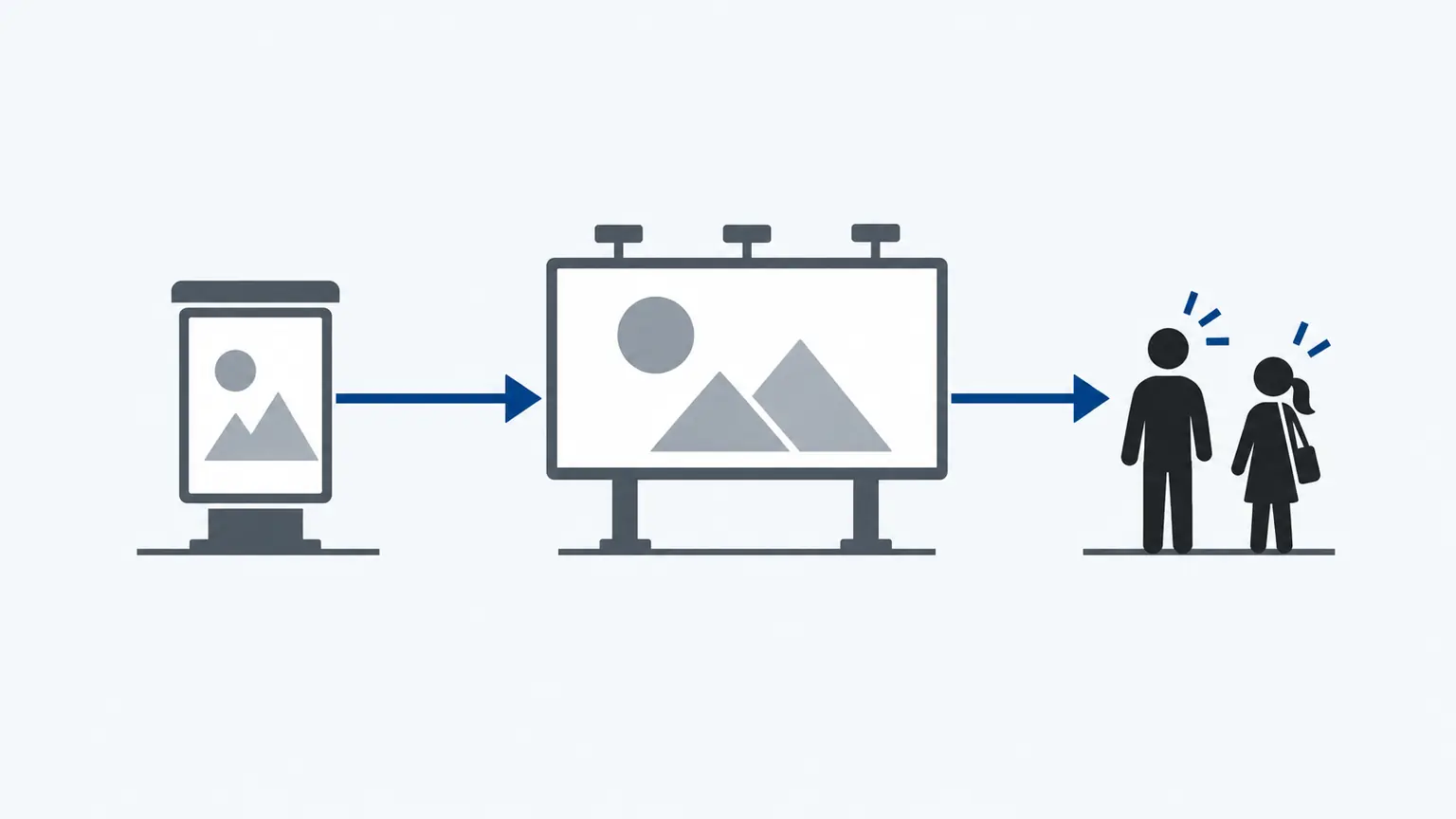
Outdoor media suits broad awareness in a defined geography, a launch that needs visible presence, a location-dependent service or a simple proposition that benefits from repetition. A new venue can advertise near its catchment area. A business attending a major trade event can use placements around the route to the venue. A national brand can build familiarity across commuter journeys.
It is harder to justify when the target audience is narrow but the locations are broad, when the proposition needs several paragraphs of explanation or when the budget buys isolated exposure with no repetition. A specialist B2B buyer may still be reachable through airport, conference, business-district or venue media, but the location evidence needs to be strong.
Define the job before choosing the format. Are you building recognition, announcing availability, directing people to a nearby location or prompting a search? Each purpose changes the site, message and measurement.
Map where your audience travels, waits and makes relevant decisions. Consider commuting routes, retail areas, venues, campuses and industry events. Compare media-owner estimates with your own customer evidence.
Inspect sites yourself where practical. A placement may have high theoretical footfall but poor visibility, a difficult viewing angle or too much surrounding clutter. Note how long people can see it, whether they are walking or driving, the likely light conditions and what competes for attention. A poster beside a platform gives more reading time than a roadside billboard, so the same artwork should not serve both without thought.
For digital out-of-home, ask about share of time, loop length, play frequency and proof that the advert was displayed. Changing a message by time, weather, stock or event stage can make the placement more relevant; running one static design on a digital screen may simply cost more.
Start with the one thing a passer-by should understand. Use a short headline, a strong visual idea and a brand mark large enough to recognise. Contrast matters more than decorative detail. Test the artwork at the size and viewing distance it will have in the real world, not only on a designer’s monitor.
Avoid making the reader perform administrative work. Long URLs, several calls to action, detailed feature lists and small QR codes are unlikely to survive a moving environment. A QR code can work where people stand still and can safely use a phone. Elsewhere, a memorable brand or search phrase may be the more realistic response mechanism.
A local directional poster should say where to go. A launch billboard should make the proposition and brand memorable. An event placement can use language that only attendees need to understand. Consistency requires the same central idea, not identical artwork everywhere.
One placement rarely creates enough repetition unless it sits on a route your audience uses frequently. Ask the media owner to explain estimated reach and frequency. Concentration often gives a growing business a better chance of being remembered than a thin spread across many areas.
Schedule around the decision. A launch needs activity before and during availability. Event media needs to appear while delegates are travelling and attending. Seasonal services need enough lead time for the audience to act. Coordinate the dates with your go-to-market plan, website, search activity, sales team and stock or delivery capacity.
Outdoor exposure is partly indirect, so build several indicators:
Use unique response routes where they remain easy to remember. Annotate campaign dates in analytics and compare relevant geography, while accounting for promotions and other activity. Do not claim every increase as an outdoor result, but do not dismiss the channel because it assists a later search rather than producing the final click.
Out-of-home often creates the first recognition that makes paid search, organic search or social activity work harder. It can support industry events and sponsorship, retail point-of-sale marketing and a broader digital marketing programme. A clear brand and value message must come first; outdoor media exposes confusion at impressive scale.
No. Local services, venues, property developments, recruitment campaigns and event-focused B2B firms can use outdoor media effectively when the geography is precise. A smaller business usually needs tighter location choices and a clearer response path because it cannot afford waste hidden inside broad reach.
Only when people have time and a safe reason to scan it. QR codes can suit stations, pedestrian areas, lifts and venues. They are a poor choice for drivers and fast-moving audiences. Make the brand and message work even if nobody scans.
Use only what the viewing time can support. A roadside format usually needs a very short headline and one visual idea, while a poster in a waiting area can carry more detail. Test comprehension under realistic conditions rather than following a universal word count.
Epitomise can help you decide whether outdoor media belongs in your marketing strategy and build the message and measurement around it.
Who wrote this

Steve founded Epitomise in 2017 after UK, international and global marketing leadership roles, most recently as Global CMO of the Vitec Group’s Videocom Division. He works with SME and technology businesses on strategy, positioning and the execution that follows — more about Steve.
Read next
A practical account-based marketing guide for selecting target accounts, coordinating sales and marketing, and measuring meaningful progress.
How to use live chat, messaging and helpful sales conversations to reduce buyer friction while protecting trust and team capacity.
Plan targeted direct mail that earns attention, supports digital campaigns and produces measurable business conversations.
A short discovery call is usually enough to tell. No deck, no pitch.
Book a discovery call