Account-based marketing: focus effort on valuable accounts
A practical account-based marketing guide for selecting target accounts, coordinating sales and marketing, and measuring meaningful progress.

Marketing guides
Partner and affiliate marketing can give you credible access to an audience that another organisation has already earned. The opportunity is not simply borrowed reach: the right partnership creates additional value for the shared customer and a sensible commercial benefit for both parties.
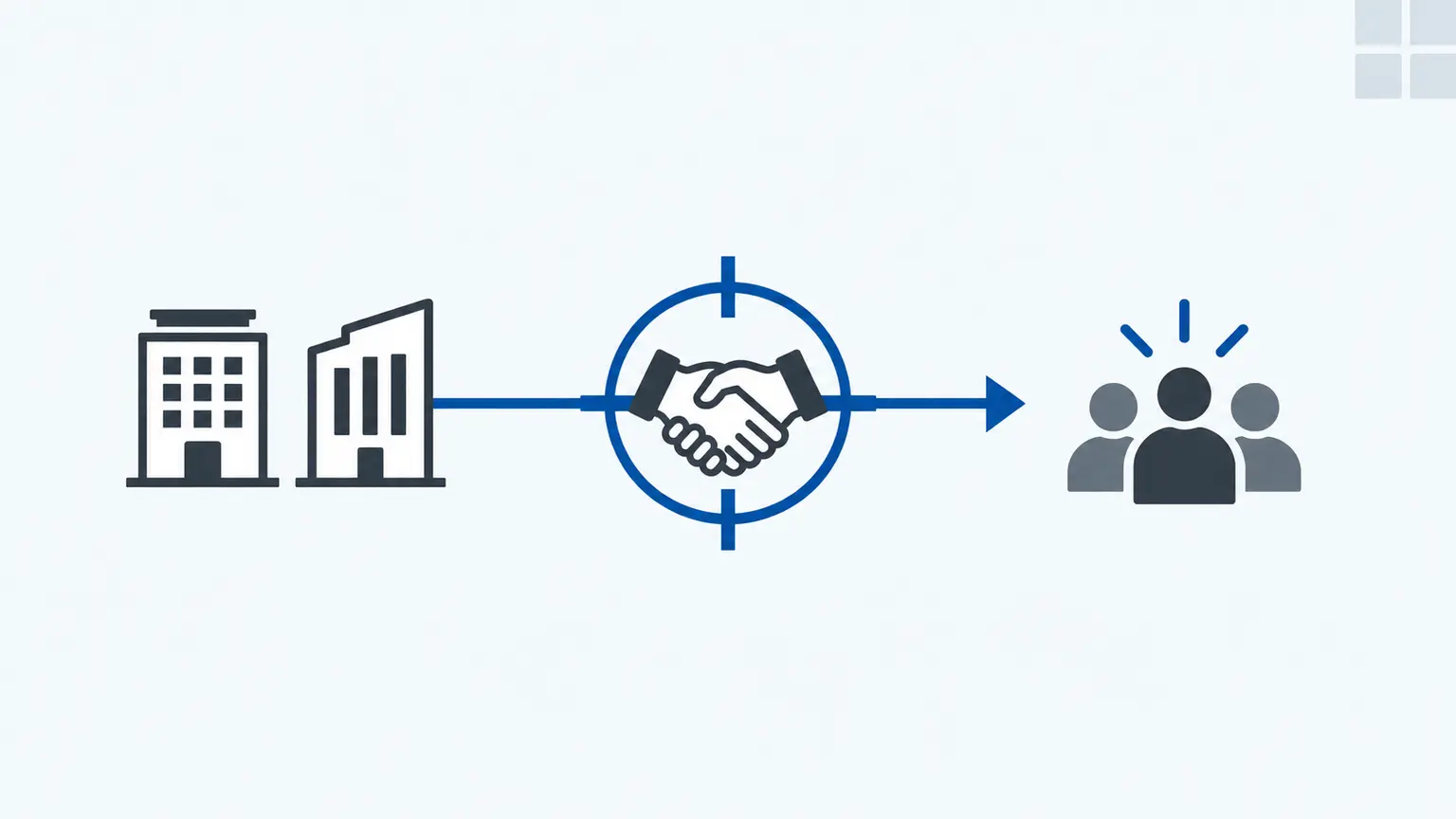
Partner marketing is joint activity between organisations with complementary capabilities, customers or routes to market. Examples include co-hosted events, bundled propositions, reciprocal introductions, integration partnerships, reseller arrangements and shared content.
Affiliate marketing is a more specific performance relationship. A publisher, creator, comparison service or other affiliate promotes an offer and receives an agreed commission when tracked actions occur. Those actions might be a sale, qualified enquiry or another defined outcome.
Both depend on alignment, but the incentives differ. A strategic partner may care about customer retention, service breadth or access to a market as well as revenue. An affiliate usually needs reliable tracking, clear terms and a conversion rate that makes promotion worthwhile. Referral marketing is often more personal and trust-led, whereas an affiliate programme formalises attribution and payment.
Partners can influence every stage. Joint content creates awareness, a recommendation supports consideration, an integration improves the offer and coordinated onboarding strengthens retention. Affiliates tend to operate in discovery and evaluation, although specialist publishers and comparison sites may reach buyers who already have strong intent.
Part 3 of Execute Your Tech Idea presents partner and affiliate activity alongside the channels each relationship can amplify. A partner might co-host an event, contribute to a webinar, introduce priority accounts or distribute useful content. The partnership is the route to an audience; the campaign still needs a clear proposition.
Map where the partner adds value rather than duplicating your existing activity. If both organisations simply email the same contacts with similar messages, reach may look larger while the customer experience becomes repetitive.
It works when the audiences overlap in a useful way, the offers complement rather than undermine each other and both sides have something credible to contribute. Strong partnerships often arise where customers already use both services or regularly ask for the missing capability.
It wastes money when an organisation pursues a famous logo without operational commitment, assumes a signed agreement will generate activity or pays affiliates for low-quality actions. A partner programme with dozens of inactive names is a database, not a channel.
Watch for incentive problems. Paying for unqualified leads rewards volume, while last-click commission can cause disputes when several channels influenced the sale. Affiliates also represent the brand: misleading claims, undisclosed promotion or inappropriate placements can create commercial and reputational risk.
Start with the customer. Identify a complementary need, audience or buying moment, then find organisations that already serve it well. Write a mutual-value statement covering the customer, your business and the prospective partner.
For a partner pilot:
For an affiliate pilot, define eligible actions, validation, commission, payment timing, attribution window, prohibited promotion and disclosure requirements. Test tracking from click through to approved conversion before recruitment. Give affiliates accurate materials and allow them to create in their own voice within clear boundaries.
For partnerships, monitor audience reached, qualified introductions, engagement, pipeline, sales, retained customers and value contributed by each side. Include the staff time required to manage the relationship. A small partnership that reliably produces good-fit opportunities may outperform a high-profile collaboration that demands constant coordination.
For affiliates, track clicks, conversion rate, approved actions, reversals, commission, customer acquisition cost, customer quality and lifetime value. Look for unusual traffic or conversion patterns rather than paying automatically for activity that meets only a technical definition.
Use agreed source and influence rules in the CRM. Review both quantitative results and relationship quality: communication, reliability, customer feedback and the partner’s willingness to continue are leading indicators of durability.
A good partner serves a relevant audience, brings a complementary capability, protects customer trust and commits resources to an agreed activity. Shared values help, but practical alignment and reliable execution determine whether the relationship works.
Use the outcome you can validate fairly and that best aligns incentives. Per-sale commission reduces lead-quality risk but may not suit long sales cycles. Per-lead payment can work when qualification is objective and fraudulent or duplicate submissions are excluded clearly.
Who wrote this

Steve founded Epitomise in 2017 after UK, international and global marketing leadership roles, most recently as Global CMO of the Vitec Group’s Videocom Division. He works with SME and technology businesses on strategy, positioning and the execution that follows — more about Steve.
Read next
A practical account-based marketing guide for selecting target accounts, coordinating sales and marketing, and measuring meaningful progress.
How to plan outdoor advertising with a clear audience, location, message and measurement approach, from local posters to digital out-of-home.
How to use live chat, messaging and helpful sales conversations to reduce buyer friction while protecting trust and team capacity.
A short discovery call is usually enough to tell. No deck, no pitch.
Book a discovery call