Account-based marketing: focus effort on valuable accounts
A practical account-based marketing guide for selecting target accounts, coordinating sales and marketing, and measuring meaningful progress.

Marketing guides
Guerrilla marketing uses an unexpected idea, setting or interaction to earn attention without relying on a large conventional media budget. The best examples feel obvious once you have seen them: the place, message and audience work together. The worst examples confuse disruption with relevance, inconvenience the public and leave the brand explaining itself for the wrong reasons.
Part 3 of Execute Your Tech Idea includes guerrilla activity in the broader channel mix. That context matters. A creative stunt is still a marketing investment, with an audience, objective, risk and next step. “It might go viral” is not a plan; it is usually an admission that distribution has not been considered.
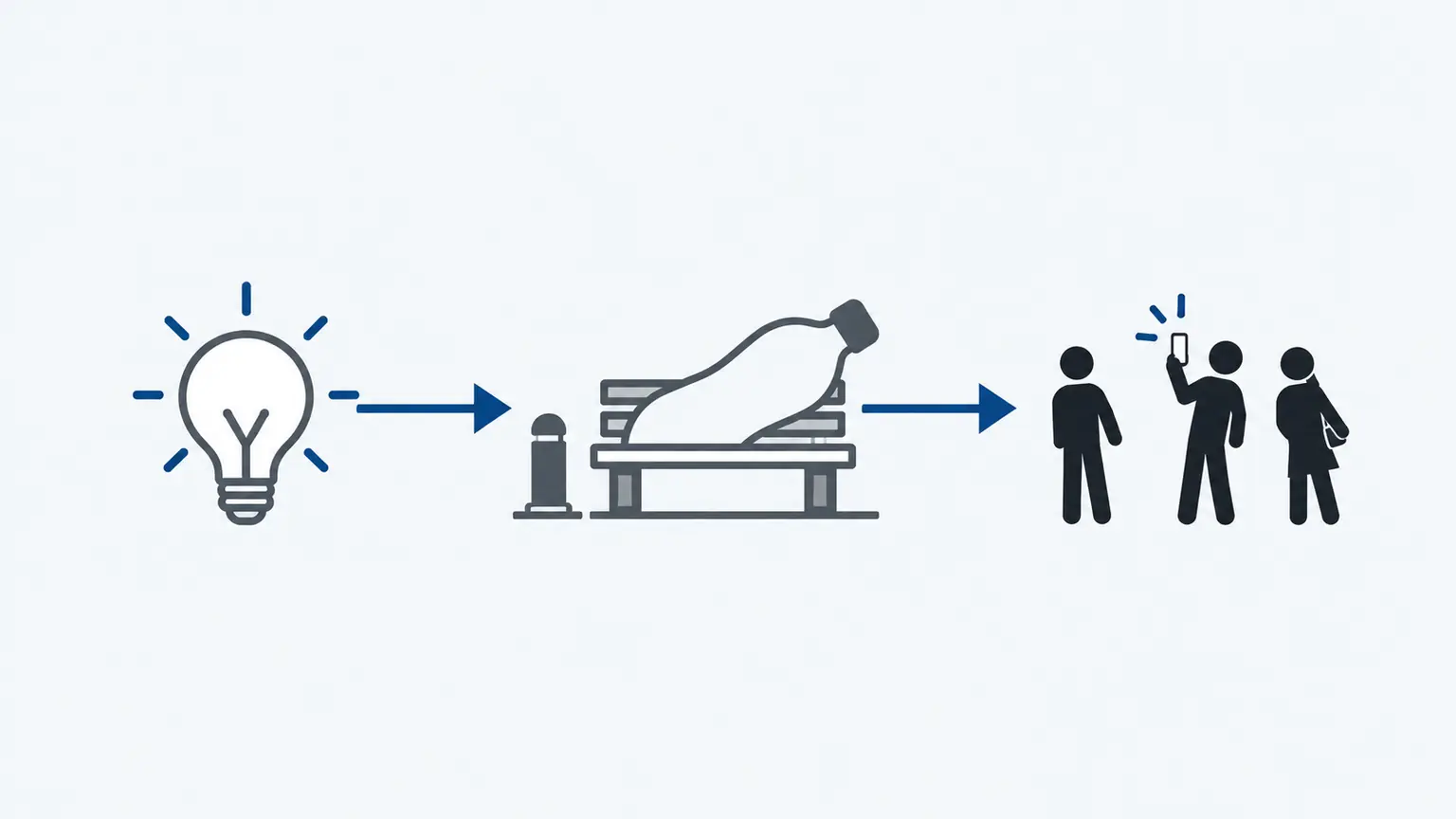
This approach suits a focused launch, local campaign, event, challenger brand or proposition that can be expressed through a physical or social idea. It can help a smaller business appear inventive and present when it cannot outspend established competitors. It is especially useful when the audience will encounter the execution in a context that adds meaning.
It is a poor fit when the brand relies on discretion, when the idea could frighten or obstruct people, when permission is unclear or when the concept needs a press release to become comprehensible. Surprise should reveal the proposition, not replace it.
Set the objective in ordinary language. Do you want the audience to notice a launch, experience a benefit, visit a location, share an idea or start a conversation? If the objective is simply “create buzz”, keep working.
Observe where the target audience goes, what they do there and what they normally ignore. A useful concept changes something familiar in a way that connects directly to the brand. It may use an installation, projection, sampling experience, pop-up, unusual partnership, street team or clever use of existing media space.
Write the connection in one sentence: “Because our offer does X, we will change Y in this place.” If that sentence feels strained, the execution may attract attention without transferring it to the brand. Test the idea with people outside the project team. Ask what they think is happening, who is behind it and what they would do next.
Keep production quality appropriate to the concept. Low-cost does not mean careless. Weather, lighting, noise, queues, transport, installation time and removal can change the experience completely. Plan what happens if the audience responds more strongly, or more weakly, than expected.
Confirm who owns or manages the location and secure written permission. Check local rules, planning or advertising requirements, licences, insurance and any restrictions applying to sampling, structures, sound, projection, filming or public gatherings. Get appropriate professional advice where the activity raises uncertainty.
Assess physical safety, accessibility, safeguarding and the effect on people who did not choose to participate. Do not block routes, imitate emergency messaging, damage property or leave waste. Consider how photographs and video will be captured and whether people need notice or consent.
Review likely interpretations, not only the intended joke. Test cultural references, timing and the risk of association with distressing events. Prepare clear ownership and escalation so the team can pause or remove the activity quickly if circumstances change.
Many guerrilla campaigns reach more people through subsequent content than through the live audience. Decide which moments need photographing or filming, who will capture them and how the story will travel. Create versions for press, social, email, partners and articles and insights without pretending that staged reach is spontaneous public enthusiasm.
Give the live audience a simple response path: a memorable URL, useful offer, location instruction or recognisable search phrase. The action should fit the experience. Forcing a long form onto a playful public moment tends to kill the goodwill you just earned.
Brief staff and partners on the message, likely questions and what they may promise. If the campaign invites participation, make the rules and any incentive clear. Have a response ready for criticism as well as praise.
Track the campaign in layers:
Record the full cost, including concept development, permissions, production, staffing, capture, distribution and clean-up. Compare the result with another way of reaching the same audience. A campaign can earn press and still fail commercially; it can also create modest public reach but work well in a tightly defined local market.
The live idea can support out-of-home advertising, events and sponsorship, influencer collaborations and local PR. Paid social can distribute strong campaign content beyond the initial audience. A coherent go-to-market plan ensures the attention lands on an offer that is ready to buy.
No. The principle is unconventional, context-led attention rather than a particular location. A business can create a surprising experience at an event, in packaging, through a partnership or within a professional community. The idea still needs permission, relevance and a route to action.
No. Media spend may be low, but concept development, permissions, fabrication, staffing, insurance, filming and distribution can be substantial. Estimate the complete campaign cost before comparing it with conventional channels.
The most common strategic risk is that people remember the stunt but not the brand or proposition. Practical risks include safety, permission, privacy, environmental impact and unintended interpretation. A strong review process protects the idea by finding these problems before the public does.
If you have a creative campaign idea and want a commercially sober review before committing, talk to Epitomise about its audience, message, risks and next step.
Who wrote this

Steve founded Epitomise in 2017 after UK, international and global marketing leadership roles, most recently as Global CMO of the Vitec Group’s Videocom Division. He works with SME and technology businesses on strategy, positioning and the execution that follows — more about Steve.
Read next
A practical account-based marketing guide for selecting target accounts, coordinating sales and marketing, and measuring meaningful progress.
How to plan outdoor advertising with a clear audience, location, message and measurement approach, from local posters to digital out-of-home.
How to use live chat, messaging and helpful sales conversations to reduce buyer friction while protecting trust and team capacity.
A short discovery call is usually enough to tell. No deck, no pitch.
Book a discovery call