Account-based marketing: focus effort on valuable accounts
A practical account-based marketing guide for selecting target accounts, coordinating sales and marketing, and measuring meaningful progress.

Marketing guides
Industry advertising puts your message inside a publication, newsletter or professional community that has already earned the attention of a particular market. That concentration can make a small specialist title more valuable than a much larger general audience. The important question is not how many people the publisher reaches. It is whether the right people notice, understand and act on your message.
In Part 3 of Execute Your Tech Idea, industry advertising and newsletters sit among the practical channels available when bringing an offer to market. They work particularly well in business-to-business markets where buyers share a trade, role, regulation or technical problem. They work poorly when a business buys a media package before deciding what it wants the audience to do.
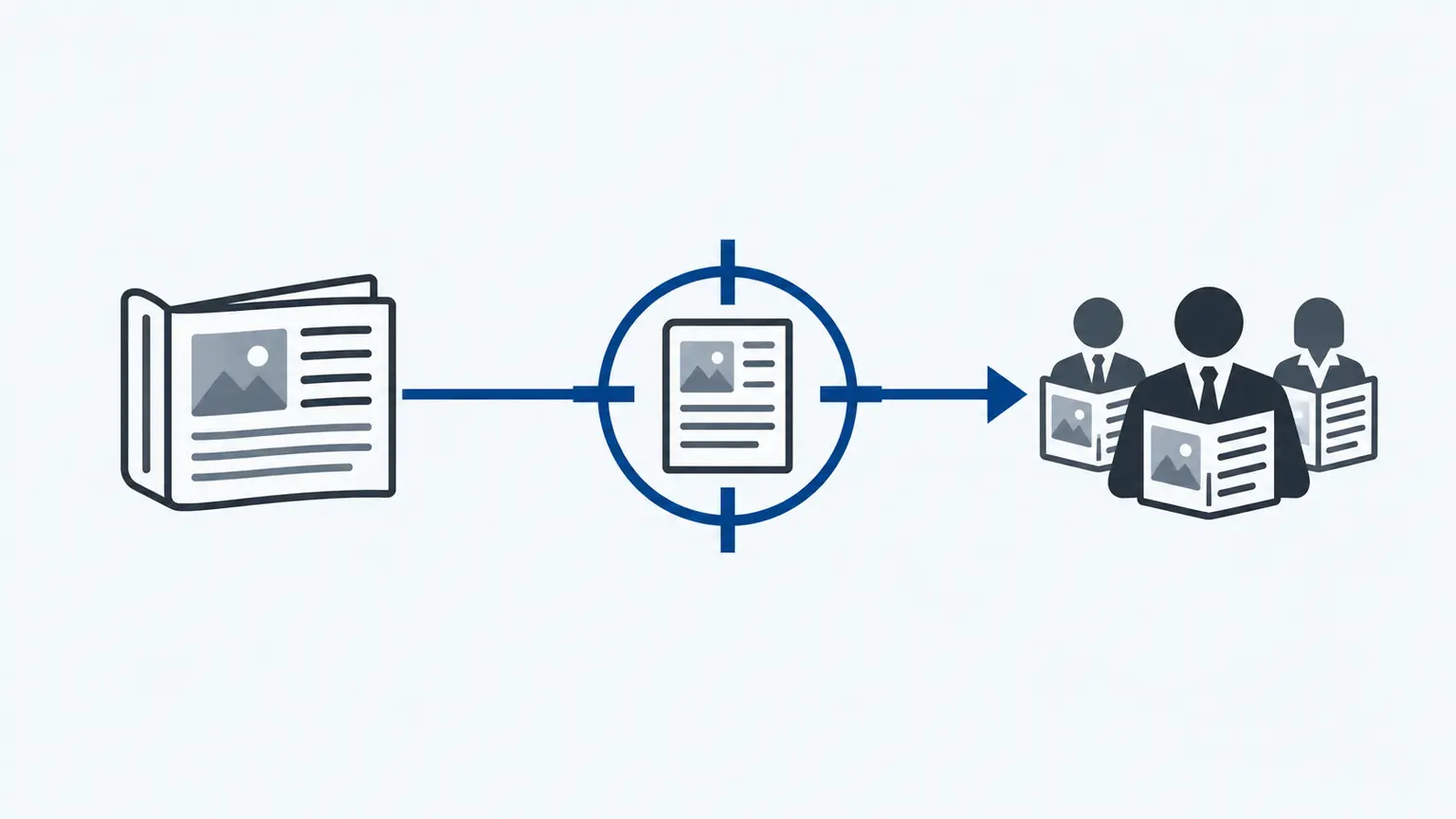
Industry media earns a place when your target market is easier to describe by professional identity than by broad demographics. A newsletter for UK facilities managers, a journal for electronics engineers or a membership publication for care providers may gather the buyers, influencers and advisers you need in one place.
It is also useful when context adds trust. A message about a technical, regulated or operational problem can carry more weight beside respected industry reporting than it does in a general social feed. The publication does not transfer its reputation automatically, but it can make the reader more willing to consider the claim.
Avoid the channel when the title cannot explain who actually reads it, when its audience includes only a thin slice of your market or when you have no relevant proposition. Repetition will not rescue a message that gives the reader no reason to care.
Ask for evidence beyond a media pack’s largest number. For print, look at verified circulation, job roles, sectors, geography and distribution. For newsletters, ask about active subscribers, average delivery, unique clicks and how often the list is cleaned. Privacy changes make open rates imperfect, so subsequent behaviour usually tells you more.
Study recent issues. Count the adverts and inspect the editorial subjects. If every email carries twenty competing messages, a cheap placement may still be expensive. Ask whether your advert could run beside direct competitors.
You should also understand the commercial relationship. A reputable publisher labels sponsored material and keeps editorial decisions separate. Paid content can still be useful, but the reader should never have to guess what it is.
A display advert can build recognition around a clear problem or proposition, but it has little room to explain. A sponsored newsletter placement can send readers to a specific guide, event or assessment. A dedicated email gives more space and focus, although it also puts more pressure on the subject line, sender reputation and relevance of the list.
Sponsored articles suit subjects that require explanation. Write them to help the reader decide, not to mimic independent praise. State the problem, show the options and explain the trade-offs.
Build a small plan that assigns one role to each placement. For example, a display advert may establish the message, a newsletter placement may offer a useful guide, and a retargeting campaign may bring interested visitors back. Trying to make one small banner build awareness, teach the market and close the sale is asking quite a lot of a rectangle.
Send the reader to a dedicated page, not the home page. Repeat the promise they clicked, answer the obvious questions and offer one next action. A publication-specific URL and tracking parameters will distinguish the traffic, while a short form or clear contact route will reduce friction.
The destination should match intent. Someone reading an early-stage industry article may want a practical marketing guide, not a sales call. Someone responding to a problem-led advert may be ready for a marketing health check. Build the next step around where the reader is, not where your quarterly target would like them to be.
Agree the measurement before the campaign starts:
Use unique landing pages, tracked links and CRM source fields, but do not pretend attribution is perfect. A senior buyer may see three print adverts, read a sponsored article and search for the brand later. Ask on enquiry, monitor branded search and compare activity from the target market during and after the campaign.
Review performance by publication, placement and proposition. A low-volume source that produces two serious conversations may deserve more investment than a high-click source that produces none.
Specialist advertising works best beside strong positioning and value messaging, useful articles and insights and direct sales activity. Publisher webinars can complement public speaking and events. Search and social retargeting can then maintain recognition after the first visit. If you sell through partners, relevant trade media may also reinforce a wider channel marketing plan.
They can be, especially where a specialist publication concentrates a hard-to-reach professional audience. Effectiveness depends on relevance, repetition, creative clarity and the destination after the click or scan. The medium is not automatically outdated, and it is not automatically valuable either.
A dedicated email gives your message more space and fewer competitors, but it usually costs more and exposes weak relevance quickly. A regular placement can build familiarity over time. Test the format against a defined outcome and compare qualified response, not simply total clicks.
There is no responsible universal number. Buy enough exposure to test the proposition without locking the budget away before you have evidence. Set a review point based on audience response and sales quality, then expand, change or stop.
Epitomise can help you assess a media proposal and connect it to a coherent demand-generation plan before you sign a long booking.
Who wrote this

Steve founded Epitomise in 2017 after UK, international and global marketing leadership roles, most recently as Global CMO of the Vitec Group’s Videocom Division. He works with SME and technology businesses on strategy, positioning and the execution that follows — more about Steve.
Read next
A practical account-based marketing guide for selecting target accounts, coordinating sales and marketing, and measuring meaningful progress.
How to plan outdoor advertising with a clear audience, location, message and measurement approach, from local posters to digital out-of-home.
How to use live chat, messaging and helpful sales conversations to reduce buyer friction while protecting trust and team capacity.
A short discovery call is usually enough to tell. No deck, no pitch.
Book a discovery call