Account-based marketing: focus effort on valuable accounts
A practical account-based marketing guide for selecting target accounts, coordinating sales and marketing, and measuring meaningful progress.

Marketing guides
Buyers rarely rely only on what a supplier says about itself. They use directories to find options, review sites to compare them and procurement frameworks to identify organisations that meet formal requirements. Used selectively, these independent routes can place your business in front of people already looking for help.
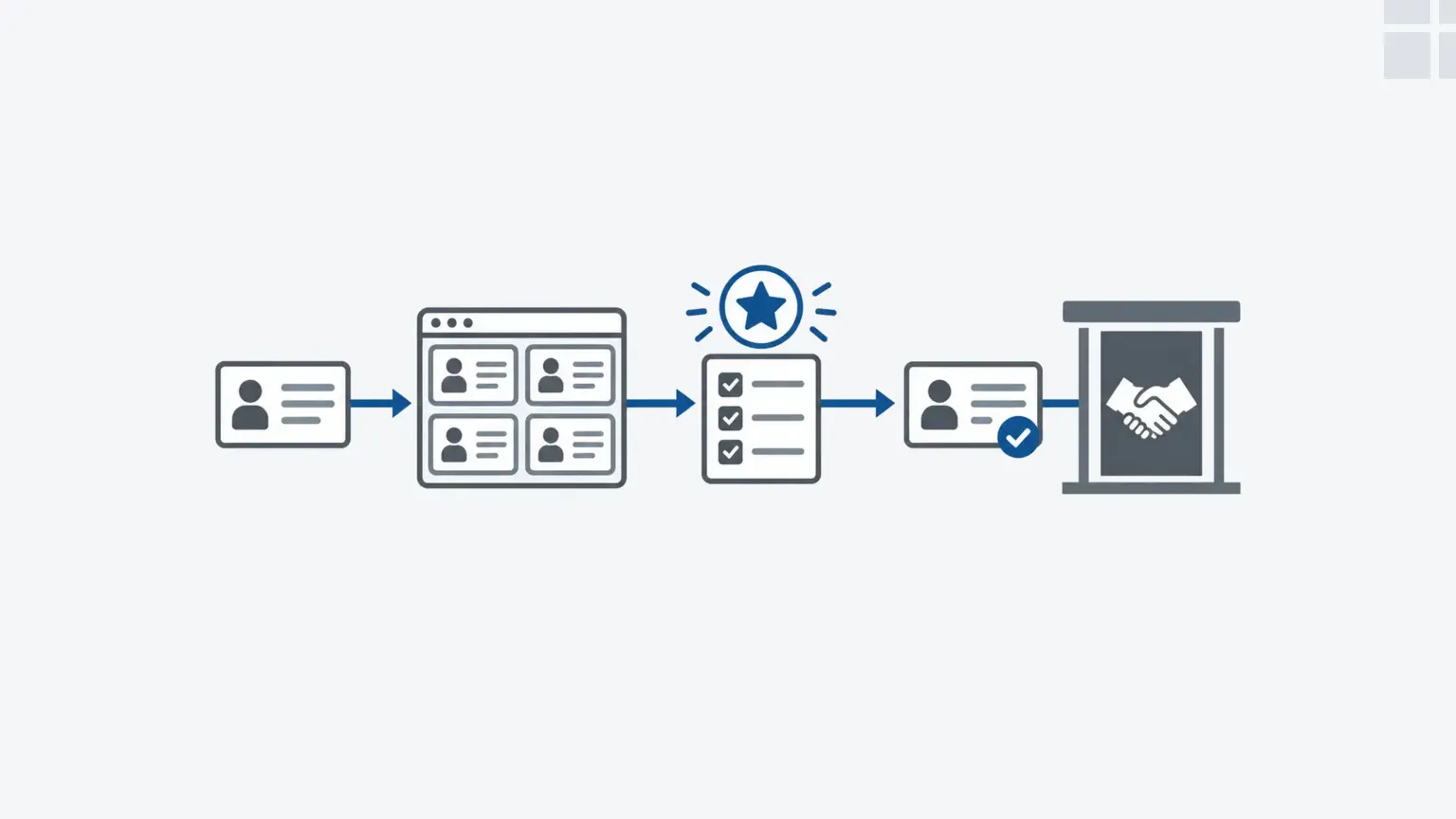
This channel combines independent sources that organise or validate suppliers. A directory may categorise businesses by service and location. A comparison or review platform helps buyers evaluate alternatives through profiles, ratings or recommendations. A procurement framework gives an eligible buying organisation an approved route to purchase from suppliers that have satisfied defined conditions.
The common feature is borrowed trust. Your own website presents your case; these sources give the customer another way to discover or verify it. In Part 3 of Execute Your Tech Idea, Steve Ward uses HR software to illustrate the point: a buyer unfamiliar with a crowded market may seek comparative information rather than approach the first supplier found.
Procurement frameworks are more formal than ordinary directories. They may open to applications only at defined times, require evidence or accreditations and impose a structured buying process. If direct access is not immediately possible, an approved partner may sometimes provide a legitimate route to the market.
Directories often support discovery: “Who provides this service in my area or sector?” Review and comparison sites support exploration and evaluation: “Which option seems credible, suitable and well regarded?” Procurement frameworks can influence the entire customer buying journey because they may determine which suppliers can be considered and how the purchase proceeds.
The channel is especially relevant when perceived risk is high. Buyers want social proof, an independent reference or reassurance that a supplier meets an accepted standard before investing time in a conversation.
It works when the source serves a concentrated audience that closely resembles your target customer. A modest specialist directory can be more valuable than a famous general platform if its users arrive with a relevant need.
The channel can also work where procurement rules matter. Public bodies and larger organisations may prefer or require established purchasing routes. Being present at the right moment can shorten supplier discovery and remove an administrative obstacle.
Free listings can collectively generate useful visibility, provided details remain accurate. Strong, genuine reviews can improve conversion even when the buyer first found you elsewhere, because prospects commonly cross-check a supplier before making contact.
Paid directory packages waste money when salespeople promote audience size without demonstrating audience fit or meaningful buying behaviour. A listing that produces visits but no suitable enquiries is not “brand awareness” by default; it may simply be irrelevant traffic.
Procurement applications can consume substantial time. If you cannot meet mandatory requirements, have little evidence, or would struggle to deliver the likely contracts, the apparent opportunity may distract you from channels where you can win now.
Review activity becomes counterproductive when businesses manufacture testimonials, pressure unsuitable customers or ignore negative feedback. Credibility comes from authentic evidence and a professional response, not an implausibly polished wall of praise.
Begin with customer research. Ask recent buyers where they looked, which comparison sources they trusted and what reassured them. Then perform the same searches they would use and record the directories, review platforms, association lists and frameworks that repeatedly appear.
Create a shortlist and assess each source against target-audience fit, authority, cost, application effort and likely purchasing intent. Claim accurate free profiles first. Use consistent contact details, a specific value proposition, appropriate categories, useful evidence and a link to the most relevant page rather than automatically sending everybody to the homepage.
Build a responsible review process into customer delivery. Ask satisfied customers for an honest review at a natural point, make the request easy and respond constructively. For frameworks, document opening dates, requirements, evidence gaps and a realistic bid/no-bid decision. Where partnership is appropriate, identify approved organisations whose wider offer genuinely benefits from yours.
Track profile impressions where available, referral visits, enquiries, qualification rate, opportunities and revenue by source. Attach campaign parameters to links you control and ask enquirers how they found you. Compare the total cost of each source, including staff time, with the value and quality of the resulting pipeline.
For reviews, measure coverage and recency rather than pursuing a perfect score. For procurement, track suitable opportunities found, applications completed, qualification or shortlist progression and contracts won.
Search engine marketing helps buyers find these independent profiles. Tenders and bids turns formal opportunities into structured responses. Partner and affiliate marketing can extend access where another supplier already holds the relevant relationships or approvals. Case studies and online expert sources strengthen the evidence a cautious buyer sees.
Treat each listing or framework as a route to a defined customer, not a badge collection. The right independent source can accelerate trust; ten irrelevant logos in the footer will not.
Who wrote this

Steve founded Epitomise in 2017 after UK, international and global marketing leadership roles, most recently as Global CMO of the Vitec Group’s Videocom Division. He works with SME and technology businesses on strategy, positioning and the execution that follows — more about Steve.
Read next
A practical account-based marketing guide for selecting target accounts, coordinating sales and marketing, and measuring meaningful progress.
How to plan outdoor advertising with a clear audience, location, message and measurement approach, from local posters to digital out-of-home.
How to use live chat, messaging and helpful sales conversations to reduce buyer friction while protecting trust and team capacity.
A short discovery call is usually enough to tell. No deck, no pitch.
Book a discovery call